Why Pakistani and Indian Food Aren't the Same Thing
They share history, geography, and many ingredients — but Pakistani and Indian cuisines are distinct traditions with different philosophies about meat, spice, bread, and the role of the meal itself.
The Conflation Problem
In the UK, “Indian restaurant” is a category that absorbs everything from the subcontinent. The tikka masala sits next to the nihari. The dosa shares a menu with the karahi. The chef might be Bangladeshi, the owner Pakistani, the recipes a negotiation between authenticity and what the local clientele expects.
This is not a complaint about restaurants — they adapt to survive. But it has created a widespread belief that Pakistani food and Indian food are the same cuisine with different labels. They are not. They share a border, a colonial history, and a pre-1947 culinary past, but the food traditions diverged meaningfully — and were already distinct in many ways before Partition.
Understanding the differences makes you a better cook. It tells you why certain spice combinations appear in one tradition and not the other, why bread plays a different structural role, and why a Lahori dinner table looks nothing like a Chennai one.
The Meat Question
The most structurally significant difference is the role of meat.
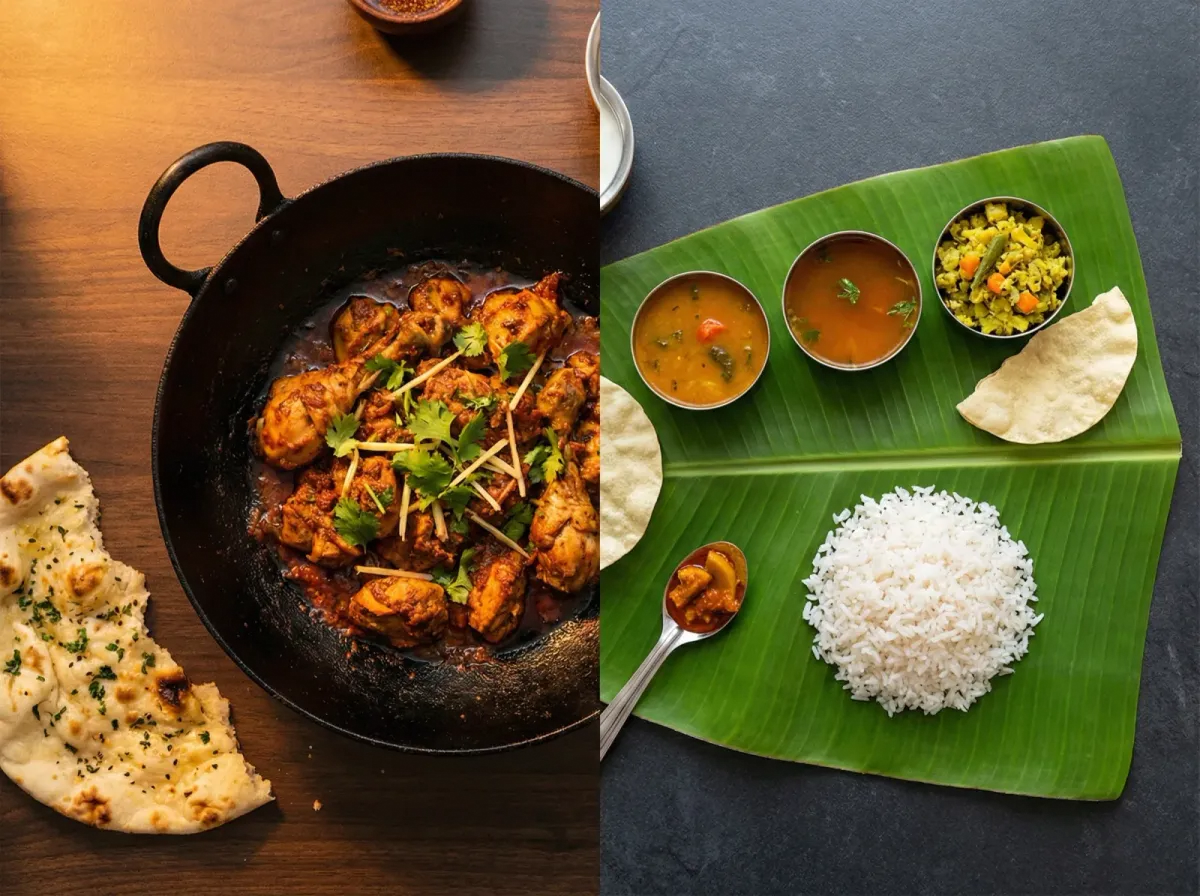
Pakistani cuisine is overwhelmingly meat-centric. Beef, mutton (goat), and chicken are not occasional additions — they are the architectural centre of most meals. A typical Pakistani dinner might be a chicken karahi or a slow-cooked beef nihari, with bread as the vehicle and perhaps a simple salad on the side. The meat is the point. Everything else supports it.
Indian cuisine is far more diverse in its relationship with meat. Large regions — particularly in the south, west, and among many communities in the north — are predominantly or entirely vegetarian. Gujarat, Rajasthan, Tamil Nadu, and Kerala each have vegetarian traditions that are not adaptations or alternatives but fully realised cuisines in their own right, with centuries of development. A Gujarati thali with fifteen components and no meat is not a meal with something missing. It is complete.
This isn’t a value judgement. It’s a structural observation: if you approach Pakistani cooking expecting significant vegetarian options, or approach South Indian cooking expecting meat at every meal, you’ll misunderstand both.
The Bread-Rice Divide
Pakistan is overwhelmingly a bread culture. Naan, roti, paratha, puri, kulcha — bread is the primary starch at most meals, and the entire format of dishes is designed around it. A karahi has thick, clinging masala because you’re tearing naan into it. Nihari has a viscous gravy because you’re soaking bread in it. Halwa puri is literally named after the bread.
India’s relationship with bread and rice is regionally complex. The north shares Pakistan’s bread orientation to a degree — Punjab, in particular, sits on both sides of the border. But move south of the Vindhyas and rice becomes dominant. South Indian meals are structured around rice: sambar and rasam are poured over it, chutneys and pickles are mixed into it, curries are designed to have enough liquid to coat rice, not to cling to bread.
This shapes the consistency of every dish. A Pakistani curry tends toward thick, reduced gravies. A South Indian curry tends toward thinner, more liquid preparations. Neither is better — they’re engineered for different delivery mechanisms.
Spice Philosophy
Both cuisines use many of the same individual spices, but the philosophy of how they’re combined and deployed is different.
Pakistani: Restraint and Heat
Traditional Pakistani cooking — not the restaurant version, the home version — uses fewer spices than most people expect. A proper karahi might use only cumin, coriander, green cardamom, black pepper, and salt. The karahi technique relies on the quality of the tomatoes, the freshness of the ginger, and the heat of the pan as much as the spice rack.
When Pakistani cooking does use complex spice blends, they tend toward warming, aromatic profiles: black cardamom, mace, nutmeg, dried ginger. The nihari masala is a good example — it’s intricate, but the dominant notes are warmth and depth rather than heat.
Chilli heat in Pakistani food comes primarily from fresh green chillies and dried red chilli powder, added with a relatively direct hand. The heat is honest and upfront.
Indian: Complexity and Regionalism
Indian spice use varies so dramatically by region that generalising is almost impossible, but some patterns hold.
South Indian cooking makes extensive use of curry leaves, mustard seeds, dried red chillies, and tamarind — ingredients that are uncommon in Pakistani cuisine. The tadka (tempering) technique of blooming spices in hot oil and pouring them over a finished dish is central to many South Indian preparations.
Bengali cooking leans heavily on mustard — mustard oil, mustard seeds, mustard paste — and panch phoron (a five-spice blend of fenugreek, nigella, cumin, black mustard, and fennel). Our shorshe ilish recipe uses mustard three ways in a single dish. This is a flavour world that has almost no overlap with Pakistani cuisine.
Kashmiri cooking, on both sides of the border, uses fennel, dry ginger, and asafoetida extensively, with a notable absence of onion and garlic in many Pandit preparations.
The point is not that one tradition is more complex than the other — it’s that they draw from different corners of the same spice library, and the combinations produce distinctly different results.
The Fat
Pakistani cooking runs on ghee, mustard oil (in some regions), and neutral oil for frying. Ghee is the prestige fat — it’s used for finishing dishes, enriching biryanis, and soaking into fresh naan.
Indian cooking uses all of these and more. Coconut oil dominates in Kerala and coastal regions. Sesame oil (gingelly oil) is common in Tamil Nadu. Mustard oil is the default in Bengal and Bihar. The fat you cook with is not a choice — it’s geography.
This matters because fat is a primary flavour carrier. A fish curry cooked in coconut oil tastes fundamentally different from the same fish cooked in mustard oil, even if every other ingredient is identical. The fat is not neutral.
The Meal Structure
A traditional Pakistani meal, particularly in Punjab and Sindh, is typically focused: one or two main dishes (usually meat), bread, and accompaniments (raita, salad, pickles, chutney). The main dish receives the attention. The rest is supporting cast.
A traditional South Indian meal — a full thali — is an ensemble: rice, sambar, rasam, two or three vegetable dishes, a dal, chutneys, pickle, papadum, curd, and sometimes a sweet. No single item dominates. The experience is the interplay between all of them across the plate.
North Indian meals, particularly Mughlai and Punjabi traditions, sit somewhere between these two models, often with multiple dishes but with one or two taking clear precedence.
The Historical Overlap
None of this means the two traditions are unrelated. They share an enormous amount:
- Mughlai cuisine — biryanis, kormas, kebabs, pulao — is a shared inheritance from the Mughal Empire that ruled much of the subcontinent. Hyderabadi biryani and Karachi biryani descend from the same tradition.
- Punjabi food straddles the border entirely. Butter chicken, dal makhani, tandoori cooking — these emerged from a region that is now split between India and Pakistan. Both countries claim them. Both are right.
- Street food culture — chaat, samosas, kebabs, pani puri — shares deep roots, though the specific preparations diverge regionally.
- The tandoor, the clay oven, is central to both traditions (and to Afghan and Central Asian cooking before either).
The shared history is real. But shared history does not mean identical present.
Why It Matters for Cooking
If you’re following a recipe, knowing whether it comes from a Pakistani or Indian tradition tells you practical things:
- Expected heat level: Pakistani recipes from Punjab tend to be more directly spicy. South Indian recipes build heat differently, often through dried red chillies tempered in oil.
- Expected consistency: Pakistani gravies are generally thicker and more reduced. Many Indian curries, particularly southern ones, are thinner and designed for rice.
- Expected fat: If a Pakistani recipe calls for oil, ghee is usually the best choice. If a Kerala recipe calls for oil, reach for coconut oil.
- Expected bread: A Pakistani dish served with bread means naan or roti. An Indian dish might mean naan, but it might also mean dosa, appam, parotta, or bhakri, depending on region.
- Vegetarian context: A “vegetarian version” of a Pakistani meat dish is an adaptation. A South Indian vegetarian dish is usually the original.
The Restaurant Menu Problem
British curry houses have spent decades presenting a unified “Indian” menu that is actually a curated selection from multiple distinct traditions, adapted for British tastes, and often executed by chefs from Bangladesh or Pakistan cooking dishes from across the subcontinent.
This isn’t a criticism — it’s how immigrant cuisine works everywhere. Chinese-American food, Tex-Mex, and Anglo-Indian curry are all legitimate cuisines that emerged from adaptation. But if your only reference point is the British curry house menu, you’ll assume that chicken tikka masala (a British invention), lamb karahi (Pakistani), and Madras curry (a British interpretation of South Indian food) all come from the same culinary tradition. They don’t.
Cooking at home — following recipes rooted in specific traditions — is how you start to see the distinctions. Make a kacchi biryani and then a Hyderabadi dum biryani. Make a karahi and then a Chettinad curry. The differences will become obvious in your hands, not just in your reading.
Not a Competition
This article is not arguing that one cuisine is better, more complex, or more authentic than the other. That argument is for social media, and it’s always stupid.
Pakistani cuisine is a focused, meat-forward, bread-centric tradition with extraordinary depth in its specific areas of excellence — slow-cooked stews like nihari, grilled meats, and a restrained but powerful approach to spice.
Indian cuisine is a continent’s worth of regional traditions — vegetarian and non-vegetarian, mild and fiery, bread-based and rice-based — with a diversity that no single article (or lifetime) can fully represent.
Both deserve to be understood on their own terms. That’s the point.