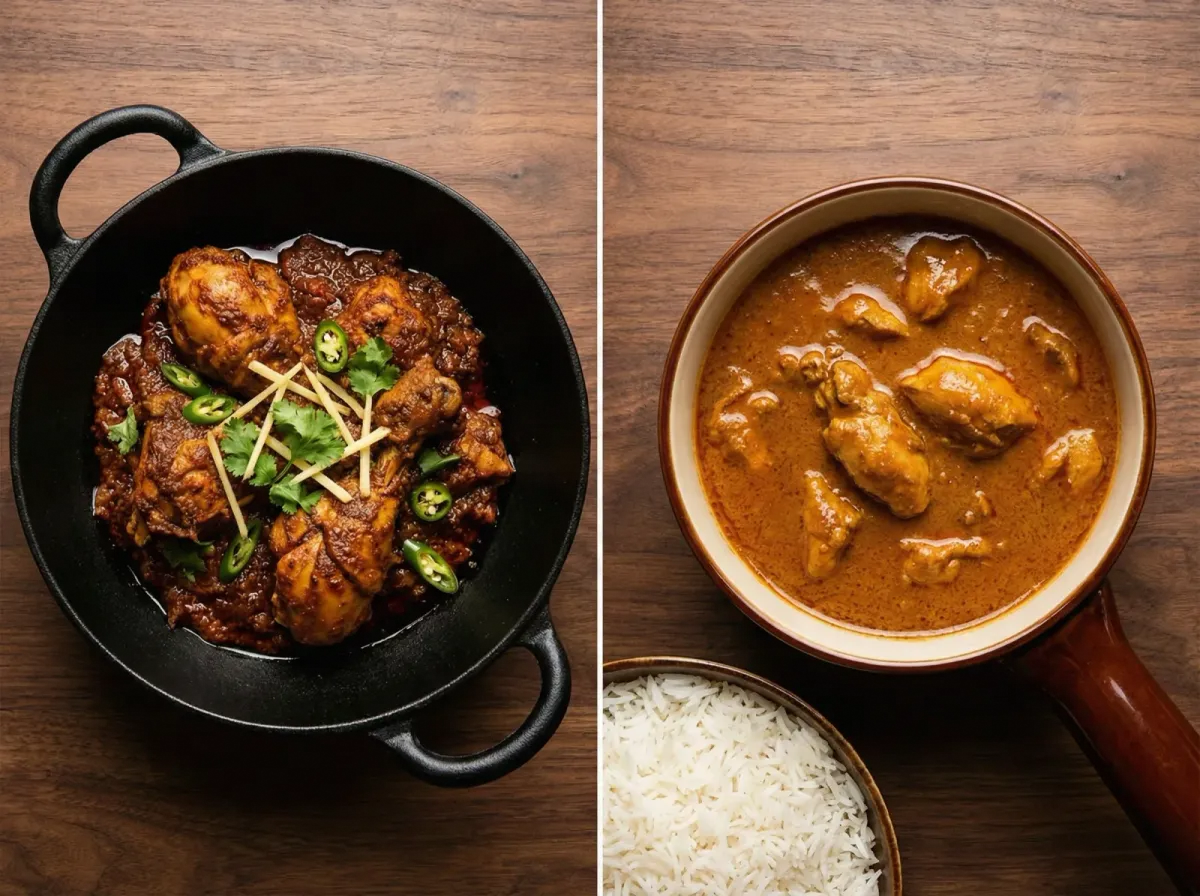
Karahi vs Curry: What's Actually the Difference?
A karahi is not a curry — the pan, heat, and spice approach are fundamentally different. Here's what separates karahi from curry (and from kadai), and why it matters for how you cook.
The Short Answer
A karahi is a specific dish cooked in a specific pan (also called a karahi — a heavy, deep, round-bottomed wok) using a specific technique: fast, high-heat cooking with minimal sauce, fresh tomatoes, and a handful of whole spices. The dish is named after the vessel.
A curry is a broad, largely British-inherited term for any South Asian dish with a sauce or gravy. It covers everything from a thin Keralan fish moilee to a dense Punjabi dal makhani. It is a category, not a recipe.
Calling a karahi a curry is like calling a stir-fry a “cooked dish.” Technically accurate. Practically useless.
The Pan
The karahi (also spelled kadai or kadhai) is a thick-walled, round-bottomed vessel with two handles, traditionally made from cast iron or heavy-gauge steel. It looks like a deep wok, and it functions similarly — the round bottom concentrates heat at the centre, and the steep sides allow you to push ingredients up and away from the heat source.
This matters because karahi cooking happens fast. You need a vessel that heats quickly, holds heat intensely, and lets you toss ingredients with control. A flat-bottomed saucepan — the default vessel for most home curries — distributes heat too evenly and too gently for karahi technique.
If you don’t own a karahi, a well-seasoned carbon steel wok is the closest substitute. A deep cast-iron skillet can work, but you lose the curved sides that make the tossing technique possible.
The Technique
This is where the real separation lies.
Karahi: Fast and Loud
A karahi is cooked on high heat, start to finish. The oil gets very hot. The whole spices go in and crackle immediately. The tomatoes hit the pan and reduce aggressively. The meat (usually chicken or mutton, cut into small pieces for fast cooking) is added and seared. The entire dish can be finished in 20–30 minutes.
The sauce — if you can call it that — is minimal. A properly made karahi should have a thick, clinging masala coating the meat, not a pool of liquid at the bottom. The tomatoes and any added yogurt reduce down into a concentrated paste that coats each piece.
Fresh ginger and green chillies are added raw at the end, retaining their sharpness. Fresh coriander goes on last. The dish is served in the karahi itself, still sizzling.
Curry: Slow and Layered
A “curry” (in the broad sense) typically involves building layers of flavour over time. Onions are cooked slowly until golden or caramelised. Ground spices are added in stages, each one bloomed in fat before the next goes in. Liquid — water, stock, coconut milk, yogurt, or cream — is added to create a sauce. The meat braises gently until tender. Our beef nihari is the extreme example — 8 hours of simmering to extract every bit of collagen from the bone.
The technique rewards patience. The onion base might take 30 minutes alone. The total cooking time can be 1–3 hours. The sauce is the star, meant to be spooned over rice.
The Spice Approach
Karahi: Whole and Simple
A traditional Pakistani karahi uses remarkably few spices — often just:
- Whole cumin seeds
- Whole coriander seeds (lightly crushed)
- Green cardamom
- Black pepper
- Salt
Some versions add a finishing garam masala, but the point is restraint. The flavour comes primarily from the tomatoes, the ginger, the chillies, and the caramelisation from high-heat cooking — not from a complex spice blend.
Curry: Ground and Complex
Most curries use ground spice blends — either pre-mixed (garam masala, curry powder, sambar powder) or built from individual ground spices (cumin powder, coriander powder, chilli powder, turmeric). The ground spices dissolve into the sauce, creating a uniform, integrated flavour.
A chicken tikka masala might use 8–12 different ground spices. A chicken karahi might use 4–5 whole ones.
A Note on “Curry” as a Word
The word curry almost certainly derives from kari, a Tamil word meaning sauce or gravy. The British colonial administration adopted it as a catch-all for any sauced South Asian dish, flattening centuries of regional, linguistic, and technique-based distinctions into a single word.
No one in Pakistan says “I’m making a curry tonight.” They say they’re making karahi, or nihari, or korma, or haleem. Each is a specific dish with a specific method. The word curry is useful in English as a broad category, but it erases specificity.
This is not a political objection — it’s a practical one. If a recipe tells you to “make a curry,” you know almost nothing about what you’re about to cook. If it tells you to make a karahi, you know the pan, the heat level, the sauce consistency, the spice approach, and the serving method.
Where They Overlap
It would be dishonest to pretend the line is always clean. Some dishes exist in the grey zone:
- Balti is essentially a karahi technique adopted by Birmingham’s Kashmiri restaurant community. It’s cooked in a small, handled steel bowl (also called a balti) at high heat with similar fast-reduction techniques. Is it a karahi? Is it a curry? It’s both and neither.
- Kadai paneer in North Indian restaurants is often cooked more like a curry than a true karahi — slower, with more sauce, using ground spices. The name references the pan but the technique has drifted.
- Railway mutton curry is a true slow curry, but its minimalist spicing (often just chilli, turmeric, and a hint of garam masala) echoes karahi simplicity.
So What Should You Cook?
Make a karahi when:
- You want dinner in 30 minutes
- You have good fresh tomatoes and ginger
- You want intense, punchy flavour with minimal sauce
- You’re serving it as the centrepiece with naan
Make a curry when:
- You have time for slow cooking
- You want a rich, abundant sauce for rice
- You’re building complex spice layers
- You’re feeding a crowd (curries scale better)
Both are valid. Both are delicious. They are simply different tools for different situations — and knowing the difference will make you a better cook.
We have a full Chicken Karahi recipe if you want to start with the real thing.