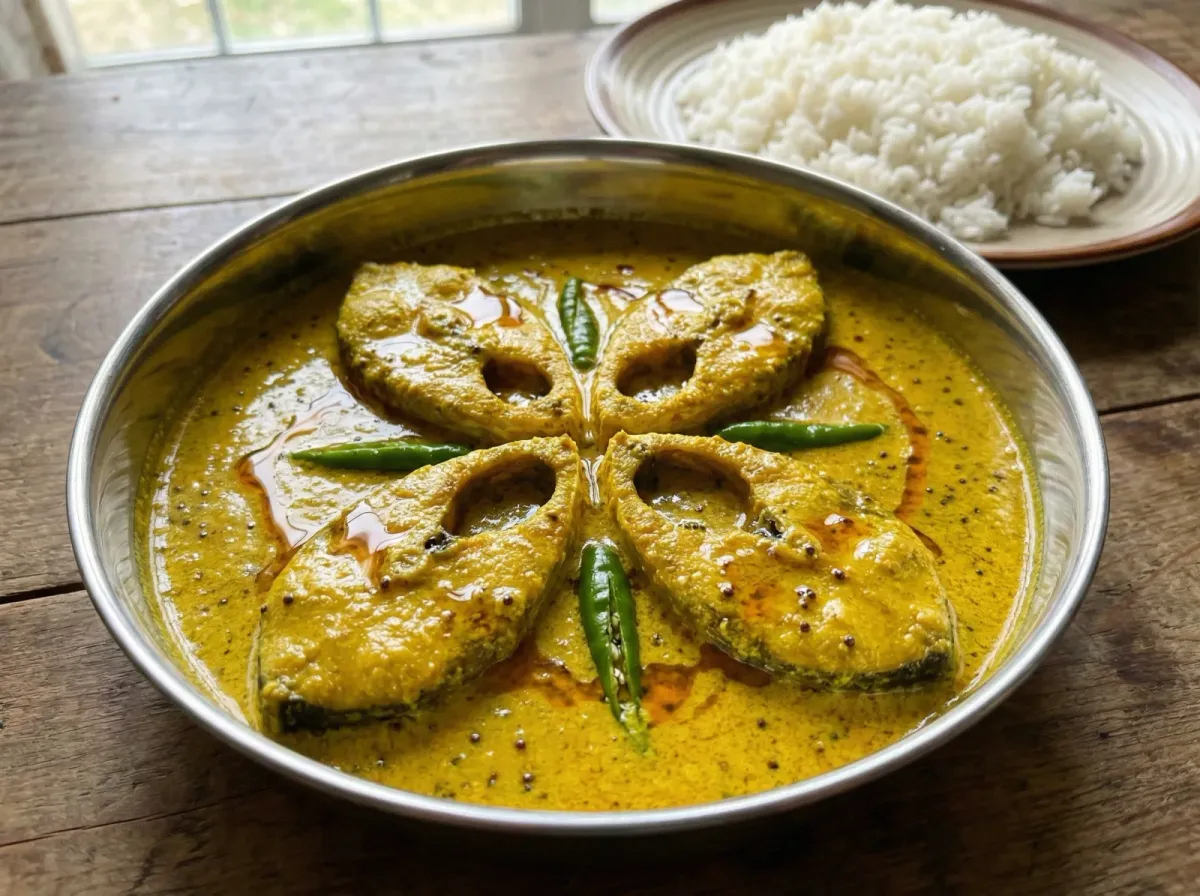
Shorshe Ilish (Hilsa in Mustard Sauce): Bangladesh's National Dish
Hilsa fish steaks cooked in a pungent paste of ground black and yellow mustard seeds, green chillies, and mustard oil — the dish that defines Bangladeshi cuisine.
Prep
25 min
Cook
25 min
Total
50 min
Serves
4
Ingredients
Fish
- 4 large hilsa (ilish) steaks, about 3cm thick — fresh or frozen
- 1/2 tsp turmeric
- 1/2 tsp salt
- 2 tbsp mustard oil (for frying)
Mustard paste (shorshe bata)
- 3 tbsp black mustard seeds
- 1 tbsp yellow mustard seeds
- 1 green chilli
- 4–5 tbsp water (for grinding)
Sauce
- 3 tbsp mustard oil
- 1/2 tsp kalonji (nigella seeds)
- 4 green chillies, slit lengthways
- 1/2 tsp turmeric
- 1/2 tsp red chilli powder (optional, for heat)
- Salt to taste
- 200ml warm water
- 1 tbsp raw mustard oil (for finishing, uncooked)
Method
- 1
Soak the black and yellow mustard seeds in water for at least 30 minutes — longer is better. This softens them and makes grinding easier. Drain.
- 2
Grind the soaked mustard seeds with the green chilli and 4–5 tbsp fresh water into a fine, smooth paste. This should be the consistency of thick cream. A wet grinder or small food processor works best — a mortar and pestle gives the most authentic texture but takes effort. This is the shorshe bata.
- 3
Rub the hilsa steaks with turmeric and salt. Heat 2 tbsp mustard oil in a non-stick or well-seasoned pan over medium-high heat until the oil just begins to smoke, then drops in temperature. Gently place the fish steaks in and fry for 1–2 minutes per side until lightly golden. The fish is delicate — handle carefully. Remove and set aside.
- 4
In the same pan, add 3 tbsp fresh mustard oil. Heat until smoking, then reduce heat to medium. Add the kalonji seeds — they'll crackle.
- 5
Add the mustard paste, turmeric, red chilli powder (if using), and salt. Stir and cook for 3–4 minutes over medium heat. The paste will splutter — keep stirring. The raw pungency will mellow as it cooks. The paste should darken slightly and the oil will begin to separate.
- 6
Add 200ml warm water and stir to create a sauce. Bring to a gentle simmer.
- 7
Carefully place the fried hilsa steaks into the sauce. Add the slit green chillies around the fish. Spoon sauce over the top of each piece.
- 8
Cover and cook on low heat for 8–10 minutes. The fish will finish cooking gently in the mustard sauce. Do not stir — the hilsa is very delicate and will break apart. Shake the pan gently if needed.
- 9
Remove from heat. Drizzle 1 tbsp of raw (uncooked) mustard oil over the top — this final hit of pungent, unheated mustard oil is traditional and non-negotiable.
- 10
Serve immediately with plain steamed rice. Nothing else.
Why This Fish Matters
Hilsa (Tenualosa ilisha) is not just a fish in Bangladesh — it is the national fish, an economic engine, a cultural symbol, and an object of genuine emotional attachment. The annual hilsa season (monsoon, roughly June to October) is a national event. Prices fluctuate daily. Quality is debated passionately. The Bangladesh government periodically bans exports to ensure domestic supply.
No other fish in the subcontinent carries this weight. And of the dozens of ways to cook hilsa, shorshe ilish — hilsa in mustard — is the preparation that sits at the centre of Bangladeshi identity.
Finding Hilsa Outside Bangladesh
This is the hard part. Fresh hilsa is seasonal and mostly available in South Asian fish markets in the UK during summer months. Frozen hilsa is more widely available year-round in Bangladeshi and Indian grocery stores — look for it labelled as ilish or hilsa.
Frozen hilsa works well for this dish. Thaw it slowly in the fridge overnight. The flesh is naturally oily and fatty, which means it survives freezing better than leaner fish.
If you truly cannot find hilsa, the closest substitutes in flavour profile (oily, rich, with many fine bones) are:
- Shad — the closest Western equivalent
- Sardines or mackerel — different texture, but the mustard sauce works beautifully with them
- Salmon steaks — not traditional at all, but the fat content holds up well against the mustard
Be aware: none of these substitutes will taste like hilsa. The fish has a flavour that is genuinely unique — rich, fatty, slightly sweet, and deeply savoury.
The Mustard Paste
The shorshe bata (ground mustard paste) is the soul of this dish. It must be made from whole mustard seeds, not prepared mustard from a jar. The combination of black and yellow seeds is important: black mustard seeds provide the sharp, pungent heat; yellow seeds add body and a milder, rounder flavour.
Soaking the seeds before grinding is essential — dry mustard seeds will not break down into a smooth paste and will taste bitter. After soaking, grind with minimal water to a thick cream.
The paste will smell aggressively pungent when raw. This is correct. Cooking mellows it dramatically, and the final drizzle of raw mustard oil at the end brings back just enough bite.
Mustard Oil
There is no substitute for mustard oil in this dish. It is not a neutral cooking fat — it is a primary flavour component, just as it is in kacchi biryani — another cornerstone of Bangladeshi cooking. The oil is used three times: for frying the fish, for cooking the paste, and raw at the end as a finishing drizzle.
In the UK, mustard oil is often sold labelled “for external use only” due to regulations around erucic acid content. Bangladeshi, Indian, and Pakistani communities use it extensively in cooking regardless. Buy it from any South Asian grocery.
The technique of heating mustard oil to its smoking point and then letting it cool slightly is traditional — it tempers the harshness while retaining the distinctive flavour.
The Bones
Hilsa is famously bony. The fine, hair-like bones are distributed throughout the flesh and are impossible to fully remove. Bengalis consider navigating the bones part of the pleasure of eating hilsa — it forces you to eat slowly and attentively, extracting every fragment of oily, mustard-coated flesh.
If this is your first time: take small pieces, chew carefully, and don’t rush. The bones are soft enough that many are edible if you chew them.
What to Serve With It
Steamed white rice. That’s it. Shorshe ilish does not need accompaniments, side dishes, or elaborate spreads. The mustard sauce is poured over the rice, the fish is placed on top, and you eat with your hands. A simple dal (lentil soup) on the side is acceptable. Anything more is a distraction.