Halwa Puri: Pakistan's Sunday Morning Breakfast
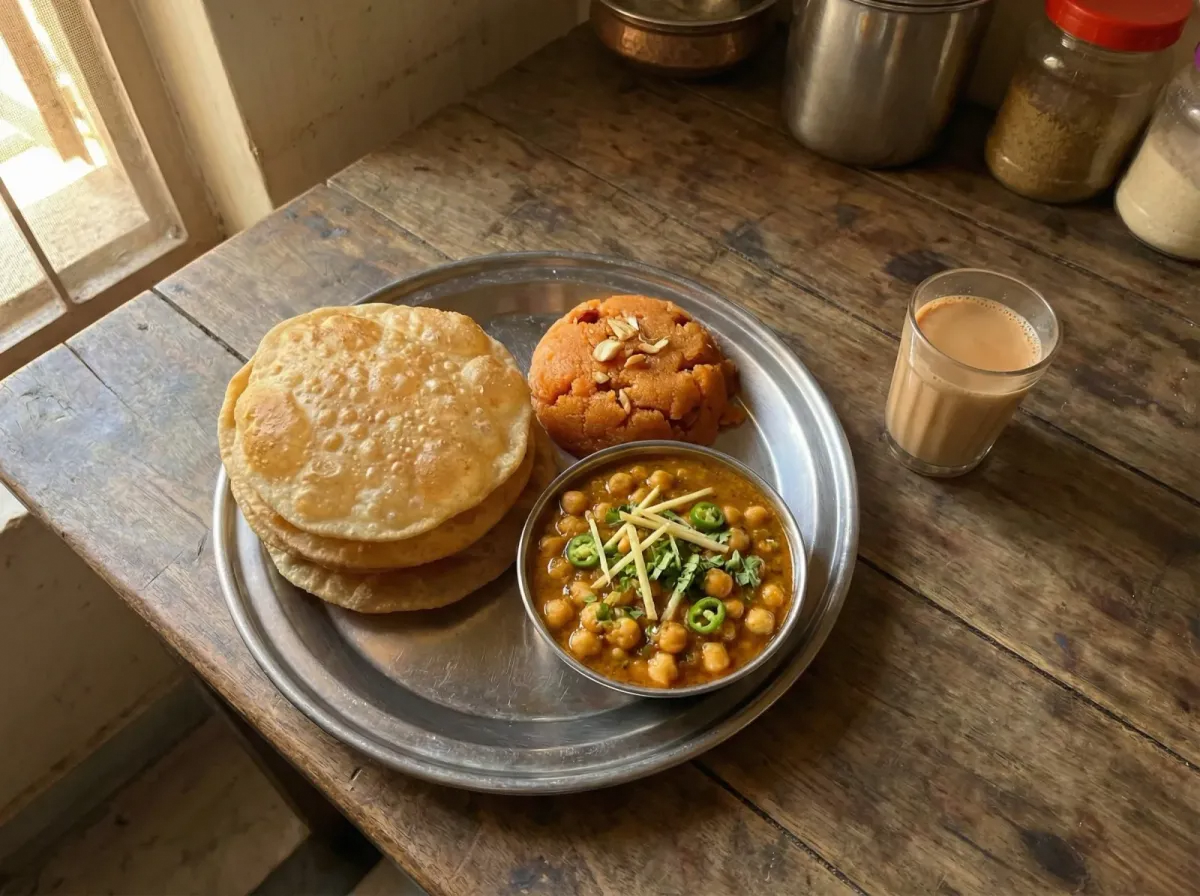
The complete Pakistani breakfast plate — crisp deep-fried puri, golden semolina halwa, and spiced chickpea curry — the meal that every household in Lahore and Karachi wakes up for.
Prep
40 min
Cook
45 min
Total
85 min
Serves
6
Ingredients
Puri dough
- 500g chapati flour (atta)
- 1 tsp salt
- 2 tbsp ghee or oil
- Warm water, enough to form a firm dough (approx 200–220ml)
- Neutral oil, for deep frying (at least 1 litre)
Sooji ka halwa
- 250g fine semolina (sooji/rava)
- 200g sugar
- 125g ghee
- 750ml water
- 4 green cardamom pods, lightly crushed
- 1/2 tsp saffron strands, steeped in 2 tbsp warm milk (optional)
- 1 tbsp blanched almonds, slivered
- 1 tbsp pistachios, slivered
- Orange food colouring (a tiny pinch, traditional — or skip it)
Channay (chickpea curry)
- 2 x 400g cans chickpeas, drained and rinsed (or 300g dried chickpeas, soaked overnight and boiled until tender)
- 3 tbsp neutral oil or ghee
- 2 medium onions, finely chopped
- 3 medium tomatoes, roughly chopped
- 1 tbsp ginger-garlic paste
- 2 tsp coriander powder
- 1 tsp cumin powder
- 1 tsp red chilli powder
- 1/2 tsp turmeric
- 1 tsp garam masala
- 1 tsp dried pomegranate seeds (anardana), ground — or 1 tbsp tamarind paste
- 1 tsp salt, or to taste
- 400ml water
- Fresh coriander, chopped
- Fresh ginger, julienned
- Green chillies, slit
- Lemon wedges
Method
- 1
Start with the channay — they benefit from time. Heat oil in a heavy pot over medium heat. Add onions and cook, stirring occasionally, for 10–12 minutes until they are golden brown and soft.
- 2
Add ginger-garlic paste, cook for 2 minutes. Add coriander powder, cumin powder, chilli powder, and turmeric. Stir for 1 minute — the spices should darken slightly and become fragrant.
- 3
Add chopped tomatoes and cook for 6–8 minutes, mashing them with the back of your spoon until they completely break down into the masala. The oil should begin to separate at the edges.
- 4
Add the chickpeas, ground anardana (or tamarind paste), salt, and water. Stir well, bring to a boil, then reduce heat and simmer partially covered for 20–25 minutes. The gravy should be thick but not dry. Use the back of your spoon to crush a handful of chickpeas against the side of the pot — this thickens the gravy naturally.
- 5
While the channay simmer, make the puri dough: combine atta, salt, and ghee. Rub the ghee into the flour until it resembles breadcrumbs. Add warm water gradually and knead into a firm, smooth dough — stiffer than chapati dough. Cover and rest for 15 minutes.
- 6
Make the halwa: heat ghee in a heavy-bottomed pan over medium heat. Add the semolina and roast, stirring constantly, for 8–10 minutes. The semolina will darken to a rich golden colour and release a nutty, toasted aroma. Do not stop stirring — it burns quickly.
- 7
Meanwhile, dissolve the sugar in 750ml water in a separate pan and bring to a boil. Add the cardamom pods and saffron milk (if using).
- 8
Carefully pour the hot sugar water into the roasted semolina — it will splutter violently, so stand back and pour with your arm extended. Stir vigorously and immediately. Add the food colouring if using.
- 9
Keep stirring over medium-low heat for 4–5 minutes. The halwa will thicken and begin to pull away from the sides of the pan as a cohesive, glossy mass. The ghee will separate and glisten on the surface. Remove from heat, scatter with almonds and pistachios, and cover to keep warm.
- 10
Fry the puris: divide the dough into golf-ball-sized portions (about 50g each). Roll each into a circle roughly 12–14cm diameter and 3mm thick — thicker than a chapati but not as thick as a paratha.
- 11
Heat oil to 180°C in a deep pan or kadai. Slide in one puri at a time. It should sink briefly, then rise and puff dramatically within seconds. Use a slotted spoon to gently press it down into the oil — this encourages full puffing. Flip once and fry until golden on both sides, about 45–60 seconds total. Drain on paper towel.
- 12
Finish the channay: add garam masala, stir, taste and adjust salt. Garnish with fresh coriander, ginger julienne, slit green chillies, and serve with lemon wedges.
- 13
Serve everything together on a thali or large plate: a pile of hot puris, a generous portion of halwa, and a bowl of channay. Eat immediately.
The Sunday Ritual
In Pakistan, halwa puri is not just a breakfast — it is a Sunday institution. The routine is set in stone: someone goes to the local halwa puri shop early in the morning and returns with a newspaper-wrapped bundle of hot puris, a steel container of halwa, and a pot of channay. The household assembles. Tea is brewed. The morning is spoken for. The only Pakistani breakfast with comparable cultural weight is nihari — but nihari takes 8 hours. Halwa puri takes one.
Making it at home is more ambitious, but that’s the point of this recipe. The shop version is convenient. The homemade version — where the puris come out of the oil puffed and blistering, the halwa is glossy and fragrant, and the channay have had time to develop depth — is better.
Three Dishes, One Plate
Halwa puri is always three things served together, and each component does a specific job:
Puri is the vehicle — crisp, puffy, hollow fried bread that you tear apart and use to scoop the channay. A good puri puffs like a balloon in the oil and stays crisp for the few minutes it takes you to eat it.
Sooji ka halwa is the sweet element — a dense, golden semolina pudding enriched with ghee and perfumed with cardamom. It sits on the plate next to the savoury components, and you alternate between the two. Sweet, then savoury. Then sweet again.
Channay are the substance — a thick chickpea curry with a deeply spiced tomato-onion gravy. The sour note from anardana (dried pomegranate seeds) or tamarind is essential — it cuts through the richness of the fried puri and the sweetness of the halwa.
The Puri Technique
A puri that doesn’t puff is a flatbread with regrets. The same principles apply to our pani puri recipe — though pani puri shells are smaller and crispier, the physics of puffing are identical. Three things determine success:
The dough must be stiff. Softer than chapati dough and the puri absorbs oil instead of puffing. You want a dough that requires firm kneading and doesn’t stick to your hands.
The oil must be hot enough. At 180°C, the puri hits the oil and the water inside the dough instantly turns to steam, inflating it. Too cool and it sits flat, absorbing oil. Too hot and the outside burns before the inside steams.
Roll to medium thickness. About 3mm — thin enough to puff, thick enough to hold structure. If you roll them paper-thin like a chapati, they’ll be crisp but flat.
The Halwa
The critical moment in halwa-making is the roasting of the semolina. You want it dark golden — considerably darker than you think. Under-roasted semolina produces a halwa that tastes raw and grainy. Properly roasted semolina has a deep, nutty sweetness that makes the halwa taste more complex than its simple ingredient list suggests.
The second critical moment is adding the sugar water. The liquid is boiling. The semolina is hot and fat-saturated. The reaction is violent. Pour from arm’s length, stir fast, and don’t lean over the pan.
The orange colour is traditional in Pakistani halwa puri shops — it comes from a pinch of food colouring and has no flavour purpose, but it gives the halwa its instantly recognisable traffic-cone hue. Skip it if you prefer the natural golden colour.
The Channay
The secret to great channay is anardana — dried pomegranate seed powder. It adds a sour, fruity tang that tamarind approximates but doesn’t quite replicate. You’ll find it in any Pakistani grocery, usually in the spice aisle. If you can’t find it, tamarind paste works well.
The other secret is crushing some of the chickpeas against the side of the pot as they simmer. This releases starch into the gravy, giving it body and thickness without adding flour or cream. You still want plenty of whole chickpeas for texture — just enough crushed ones to make the gravy cling.
Timing
The challenge of halwa puri at home is getting all three components hot and ready simultaneously. The order matters:
- Start the channay first — they take longest and hold well on low heat
- Make the halwa second — it stays warm covered for at least 30 minutes
- Fry the puris last — they must be served immediately
This means the puris hit the table hot while everything else is ready and waiting. If the puris go cold, the entire exercise loses its purpose.