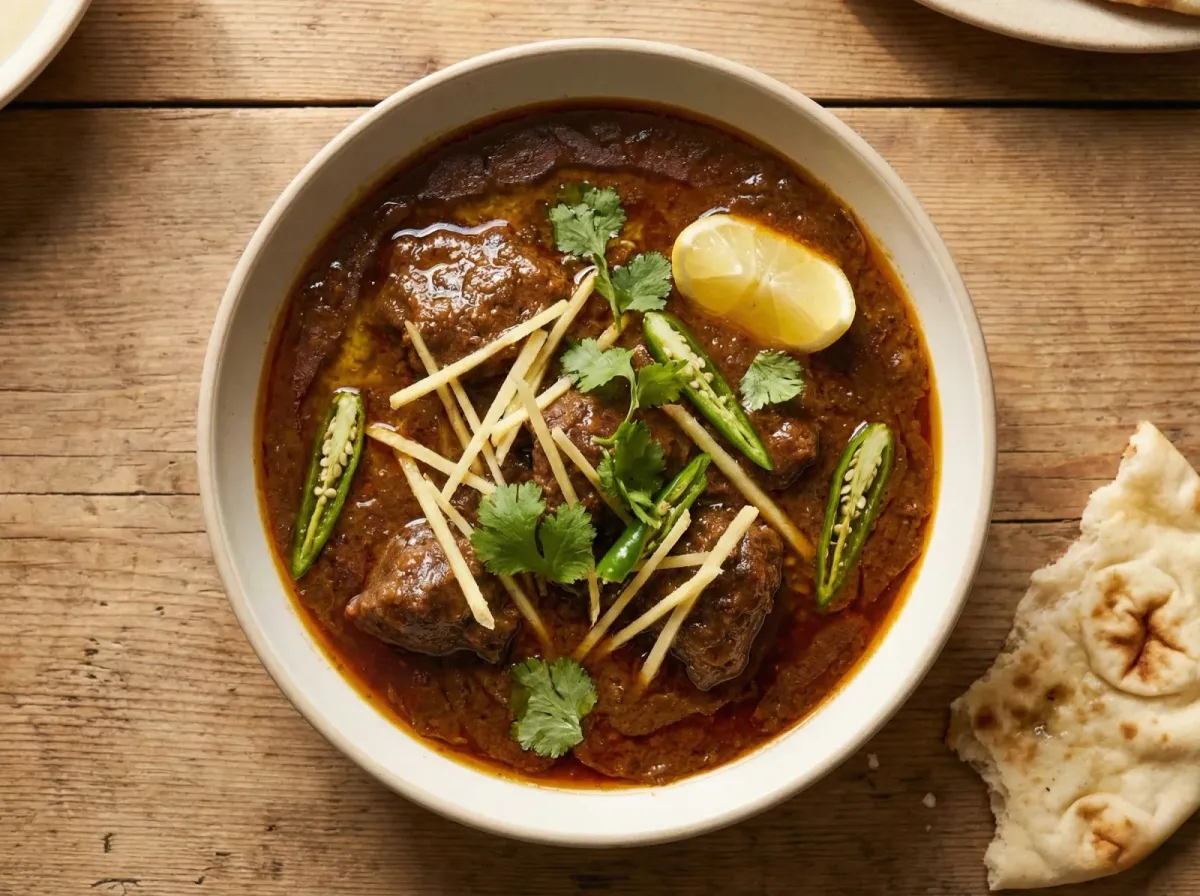
Authentic Beef Nihari: Lahore's Slow-Cooked Breakfast Stew
Bone-in beef shank simmered for hours in a flour-thickened spice broth until the marrow dissolves into the gravy — the dish that built Lahore's food reputation.
Prep
30 min
Cook
480 min
Total
510 min
Serves
6
Ingredients
Meat
- 1.5kg bone-in beef shank (nalli), cut into large pieces — ask your butcher to keep the marrow bones
- 250g boneless beef, cubed (optional, for extra body)
- 3 tbsp neutral oil or ghee
- 2 litres water
Nihari masala (grind fresh)
- 1 tbsp fennel seeds
- 2 tsp cumin seeds
- 1 tsp black peppercorns
- 6 green cardamom pods
- 4 black cardamom pods
- 6 cloves
- 2 blades mace (javitri)
- 1/2 nutmeg, grated
- 2-inch piece cinnamon
- 2 bay leaves
- 1 tsp dried ginger powder (sonth)
- 1/2 tsp kalonji (nigella seeds)
Base spices
- 3 large onions, very thinly sliced
- 2 tbsp ginger-garlic paste
- 2 tsp red chilli powder (Kashmiri for colour, or a mix)
- 1 tsp turmeric
- 2 tsp salt, or to taste
Thickening and finishing
- 4 tbsp chapati flour (atta), dry-roasted until fragrant and mixed with 200ml water into a smooth slurry
- 2 tbsp ghee
- Fresh ginger, cut into fine julienne
- Fresh green chillies, slit
- Fresh coriander leaves
- Lemon wedges
- Thinly sliced onion rings
Method
- 1
Dry-roast all the whole spices for the nihari masala in a pan over medium heat for 2–3 minutes until fragrant. Cool completely, then grind to a fine powder. Set aside.
- 2
Heat oil or ghee in a large, heavy-bottomed pot over medium-high heat. Add the sliced onions and fry, stirring frequently, for 15–20 minutes until they are deeply golden brown — nearly burnt. This colour is the foundation of nihari's dark gravy.
- 3
Add ginger-garlic paste and cook for 2 minutes until raw smell disappears. Add chilli powder and turmeric, stir for 30 seconds.
- 4
Add the beef shank pieces and any boneless beef. Sear on all sides for 5 minutes. The meat doesn't need to brown completely — it just needs initial contact with the spiced onion base.
- 5
Add the ground nihari masala and salt. Stir to coat every piece of meat. Cook for 2 minutes.
- 6
Pour in 2 litres of water. Bring to a boil, then reduce heat to the lowest possible setting. Cover with a tight-fitting lid.
- 7
Cook for a minimum of 6 hours — 8 is better. The meat should be falling off the bone and the marrow should have dissolved into the gravy. Check occasionally and top up with a little hot water if the level drops below the meat.
- 8
In the final 30 minutes, prepare the flour slurry: dry-roast the chapati flour in a small pan, stirring constantly, until it smells nutty and turns a shade darker. Mix with 200ml water until completely smooth with no lumps.
- 9
Pour the flour slurry into the nihari in a thin stream, stirring continuously. This thickens the gravy to its characteristic silky, almost gelatinous consistency. Simmer uncovered for 20 minutes.
- 10
Finish with a tablespoon of ghee floated on top. Serve in wide shallow bowls, garnished with ginger julienne, slit green chillies, fresh coriander, lemon wedges, and raw onion rings. Accompany with fresh naan.
What Nihari Actually Is
Nihari comes from the Arabic nahar, meaning morning. It is Lahore’s original breakfast — a stew that was put on the fire after the last prayer of the night and cooked through until dawn, when labourers, scholars, and everyone between would eat it with fresh naan before the day began. If the chicken karahi is Pakistani cooking at its fastest — high heat, 30 minutes, done — nihari is the opposite end of the spectrum. This is slow cooking as philosophy.
The Lahore version — what this recipe follows — is the richest, with a thick, marrow-heavy gravy. Karachi nihari tends to be spicier and slightly lighter in body, using more whole spices and less flour. Both cities claim the definitive version; both are worth eating.
The defining feature of nihari is not its spice mix (though that matters) but its cooking time. This is a dish that improves with every hour it spends on the flame. The collagen from the bone-in shank dissolves into the gravy. The marrow melts. The flour thickening creates a body that coats the back of a spoon and clings to torn pieces of naan. Nothing about this can be rushed.
The Marrow Is the Point
If your butcher offers you boneless beef for nihari, politely decline. The bone marrow is what separates real nihari from a spiced beef stew. As the shank bones cook for 6–8 hours, the marrow gradually liquefies into the gravy, giving it a richness and unctuousness that no amount of ghee can replicate.
Ask for beef shank cut across the bone — nalli pieces — so the marrow is exposed to the liquid. Some Lahori nihari houses add extra marrow bones to the pot for this reason.
The Flour Thickening
The atta (chapati flour) slurry is a technique specific to nihari. It’s not a roux — there’s no fat involved. The flour is dry-roasted first to remove the raw taste and develop a nutty flavour, then mixed with water and stirred into the pot near the end.
This is what gives nihari its signature texture: silky, thick, almost gelatinous. The gravy should cling to naan, not run off it. If your nihari looks like soup, it needs more flour slurry and more time.
Why This Takes So Long
You cannot make good nihari in 2 hours. Pressure cookers can tenderise the meat, but they cannot replicate what 6–8 hours of gentle simmering does to the spice integration and the gelatin extraction from the bones. The flavour compounds in the whole spices need time to fully release and meld with the rendered fat and collagen.
If you must use a pressure cooker, give it at least 90 minutes under pressure, then uncover and simmer for another hour. It won’t be the same, but it will be respectable.
The only other dish on this site that demands comparable patience is Hyderabadi haleem — a different tradition, but the same commitment to time as an ingredient.
The Taar
In the best nihari houses in Lahore — places like Muhammadi Nihari or Malik Nihari — they practice taar, which means keeping a portion of yesterday’s nihari gravy and adding it to today’s pot. Over weeks, months, even years, this creates a depth of flavour that is genuinely unreplicable in a home kitchen.
You can approximate this by making nihari one day, refrigerating the leftover gravy, and using it as the base for your next batch. After three or four cycles, you’ll notice the difference.
How to Serve
Nihari is always served with:
- Fresh naan — not roti, not paratha. The soft, pillowy naan is essential for soaking up the gravy.
- Ginger julienne — raw, sharp, and cut into thin matchsticks.
- Slit green chillies — for heat on demand.
- Lemon wedges — a squeeze of acid cuts through the richness.
- Raw onion rings — for crunch and sharpness.
- Fresh coriander — scattered generously.
Each person assembles their own bowl. The garnishes are not decoration — they are structural to the eating experience.