10 Must-Try Sri Lankan Dishes You Can Make at Home
A home cook's guide to 10 essential Sri Lankan dishes, from kottu roti and coconut fish curry to lamprais, devilled prawns, and watalappan.
Sri Lankan Food Is Built on Contrast
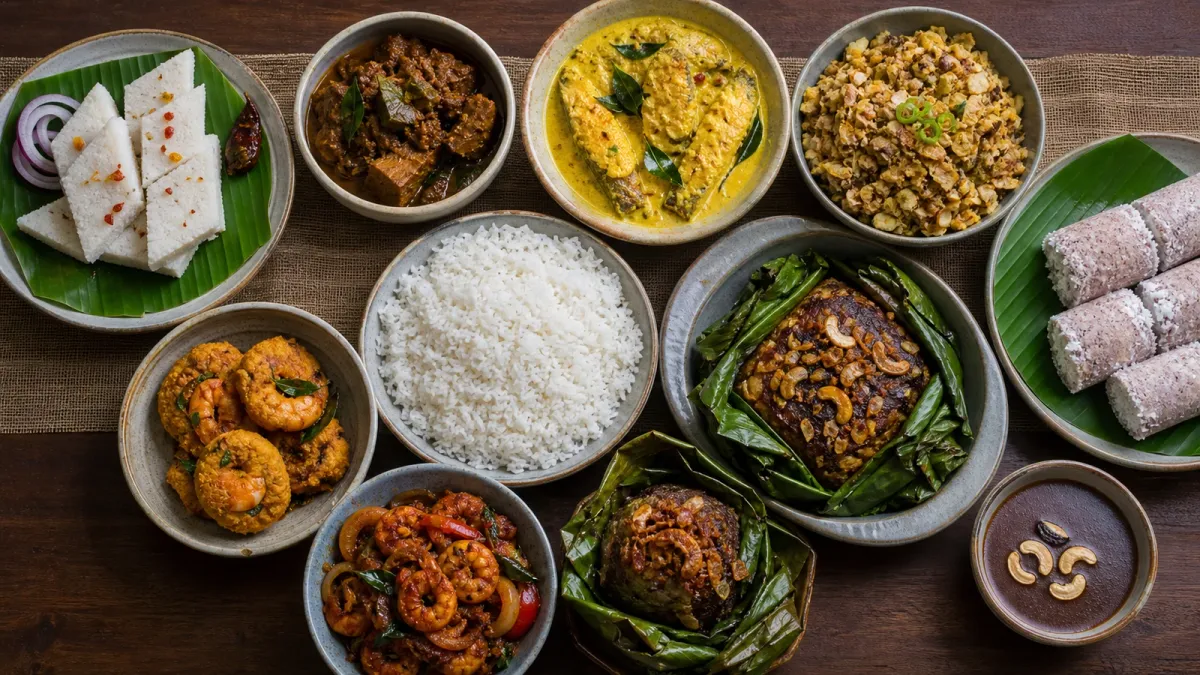
Sri Lankan food makes its point through contrast. A rich coconut curry lands beside a raw, sharp sambol. Soft rice carries crisp fried onions, roasted spices, sour goraka, and fresh curry leaves. A quiet breakfast of rice and coconut belongs to the same cuisine as a griddle full of kottu being chopped loudly after dark.
That range is why a useful Sri Lankan food guide cannot stop at restaurant favourites. The dishes below show you how the cuisine works at home: how coconut changes from milk to grated flesh, how rice becomes several completely different foods, and how Sinhalese, Tamil, Malay, and Burgher traditions all belong on the same island table.
These are not ten versions of curry. They include celebration food, breakfast, street snacks, flatbread, seafood, dessert, and one of South Asia’s most elaborate rice parcels. Together, they give you a practical route into Sri Lankan cooking.
1. Kottu Roti
Kottu roti is the dish most people hear before they taste. Cooks chop strips of godamba roti with egg, vegetables, curry sauce, and meat between two metal blades on a hot griddle. The blades mix, cut, and fry at once, producing soft edges, crisp patches, and a rhythm that defines Sri Lankan street food after dark.
At home, the important part is not copying the performance. It is controlling moisture. The roti needs enough curry sauce to absorb flavour without turning soggy, while high heat keeps the vegetables lively and the egg distinct. Kottu teaches you one of the cuisine’s best habits: leftovers are not merely reheated, but rebuilt into something with its own identity.
2. Sri Lankan Fish Curry
Sri Lanka has many fish curries, from fierce red malu mirisata to gentler coconut-based versions. Our Sri Lankan fish curry is malu kirata, with firm fish simmered in coconut milk, roasted curry powder, fenugreek, curry leaves, and goraka. It is creamy, sour, fragrant, and hot in measured layers.
This is the best single dish for understanding how Sri Lankan curry differs from a generic curry powder recipe. The spices are roasted for depth, the sourness is structural, and the coconut milk softens the chilli without erasing it. Keep the simmer gentle so the fish stays whole and the coconut milk stays smooth.
3. Kiribath
Kiribath is short-grain rice cooked with thick coconut milk, pressed into a slab, and cut into diamonds. It appears at Sinhala and Tamil New Year, in new homes, at birthdays, and at other beginnings. Its short ingredient list is exactly why every detail matters.
Use starchy rice, cook it until the grains bind, and press it while hot. Then serve it with lunu miris, a coarse relish of red chilli, onion, lime, and often Maldive fish. The mild rice and fierce relish are a complete lesson in Sri Lankan balance, and kiribath is the easiest dish on this list for a new cook.
4. Pittu
Pittu turns rice flour and grated coconut into light steamed cylinders. The mixture is not made into a dough. You dampen it only until it forms a loose crumble, layer it with coconut in a pittu mould, and let steam hold it together.
The texture should stay soft and granular, never dense or gummy. Pour warm coconut milk over it at the table and pair it with dhal, fish curry, or a dry meat curry. Pittu shows how Sri Lankan cooking can make rice feel entirely new without adding complexity for its own sake.
5. Godamba Roti
Godamba roti is the thin, elastic flatbread that gives kottu its chew, but it deserves to be eaten before it reaches the chopping blades. The dough is enriched with oil, rested until highly extensible, stretched almost translucent, folded, and cooked on a hot griddle.
Resting matters more than forceful kneading here. A relaxed dough stretches without tearing and folds into flaky layers that can pull apart at the table. Eat it warm with fish curry, or make a full batch knowing that tomorrow’s pieces can become kottu.
6. Polos Curry
Polos curry uses young green jackfruit as a vegetable in its own right, not as an imitation of meat. The jackfruit simmers slowly with roasted curry powder, goraka, aromatics, and coconut milk until its fibres turn tender and the gravy clings to every piece.
This curry rewards patience twice. The long cook gives the jackfruit time to absorb the spice-rich liquid, and a rest after cooking deepens the flavour again. Make it ahead when you are building a rice and curry spread; it will usually taste better by the time everything else reaches the table.
7. Isso Vadai
Isso vadai crowns coarse lentil fritters with whole prawns before frying them until crisp. The lentil base has South Indian roots, but the prawn-topped version has become unmistakably Sri Lankan. It is a street snack built around one excellent contrast: rough, crunchy dal around a sweet, juicy prawn.
The batter must be coarse enough to stay craggy but damp enough to hold together in the oil. Flatten the patties so the centre cooks before the surface darkens, and press the prawns in firmly. Eat them hot with a sharp onion relish or pol sambol.
8. Watalappan
Watalappan is a steamed custard of coconut milk, eggs, kithul jaggery, and warm spices. It comes from Sri Lanka’s Malay culinary tradition and now appears across the island at Eid, weddings, celebrations, and family meals. The flavour should be dark and caramel-like, with cardamom and cloves supporting the jaggery rather than covering it.
Steam the custard gently and remove it while the centre still has a slight wobble. Too much heat gives you bubbles and a rubbery set. Chilled and topped with roasted cashews, watalappan is rich enough to close a large meal without needing cream, pastry, or decoration.
9. Lamprais
Lamprais is a complete meal wrapped in banana leaf and baked until every component shares the leaf’s deep aroma. Traditional Dutch Burgher versions bring together rice cooked in stock, mixed meat curry, frikkadels, brinjal pahi, ash plantain, seeni sambol, and belacan. The parcel is compact, rich, and deliberately more complex than an everyday packet of rice and curry.
The banana leaf is not packaging added at the end. Passing it over a flame makes it pliable, and baking the filled parcel perfumes the rice while bringing the separate curries into one composed meal. Lamprais teaches an important point about Sri Lankan food: colonial influence was not copied unchanged, but transformed through local ingredients, communities, and taste.
10. Devilled Prawns
Devilled prawns are fast, glossy, sweet, sour, and unapologetically hot. Prawns are tossed over high heat with onion, capsicum, tomato, chilli, and a punchy sauce until the outside is coated and the centre stays juicy. Unlike a slow curry, this dish depends on speed and reduction.
Cook the prawns briefly, keep the vegetables crisp, and reduce the sauce only until it clings. The dish should not sit in a pool of gravy. Serve it with rice for dinner or as part of a larger spread when you need something bright and immediate beside gentler coconut dishes.
Where to Start
Start with kiribath if you are completely new to Sri Lankan cooking. It uses familiar ingredients, teaches you the cuisine’s love of coconut and contrast, and gives you a finished dish without specialist equipment.
Choose the fish curry if you want one dinner that shows the cuisine at full volume. You will learn roasted spice, coconut milk control, curry leaves, and souring in a single pot. Make kottu roti when you want the most theatrical option, especially if you already have godamba roti ready.
Build Your First Sri Lankan Table
A Sri Lankan meal works through relationships rather than one oversized centrepiece. For a balanced first spread, build around:
- Steamed rice or fresh pittu as the mild base
- Fish curry for a fragrant, coconut-rich sauce
- Polos curry for a darker, slower, more concentrated curry
- A fresh sambol or onion relish for heat, acidity, and crunch
- Watalappan served cold at the end
You do not need to make all ten dishes at once. Cook one, understand what makes it specific, and then add the next dish that contrasts with it. That is the clearest way to discover Sri Lankan food: not as a wall of heat, but as a table built from balance.