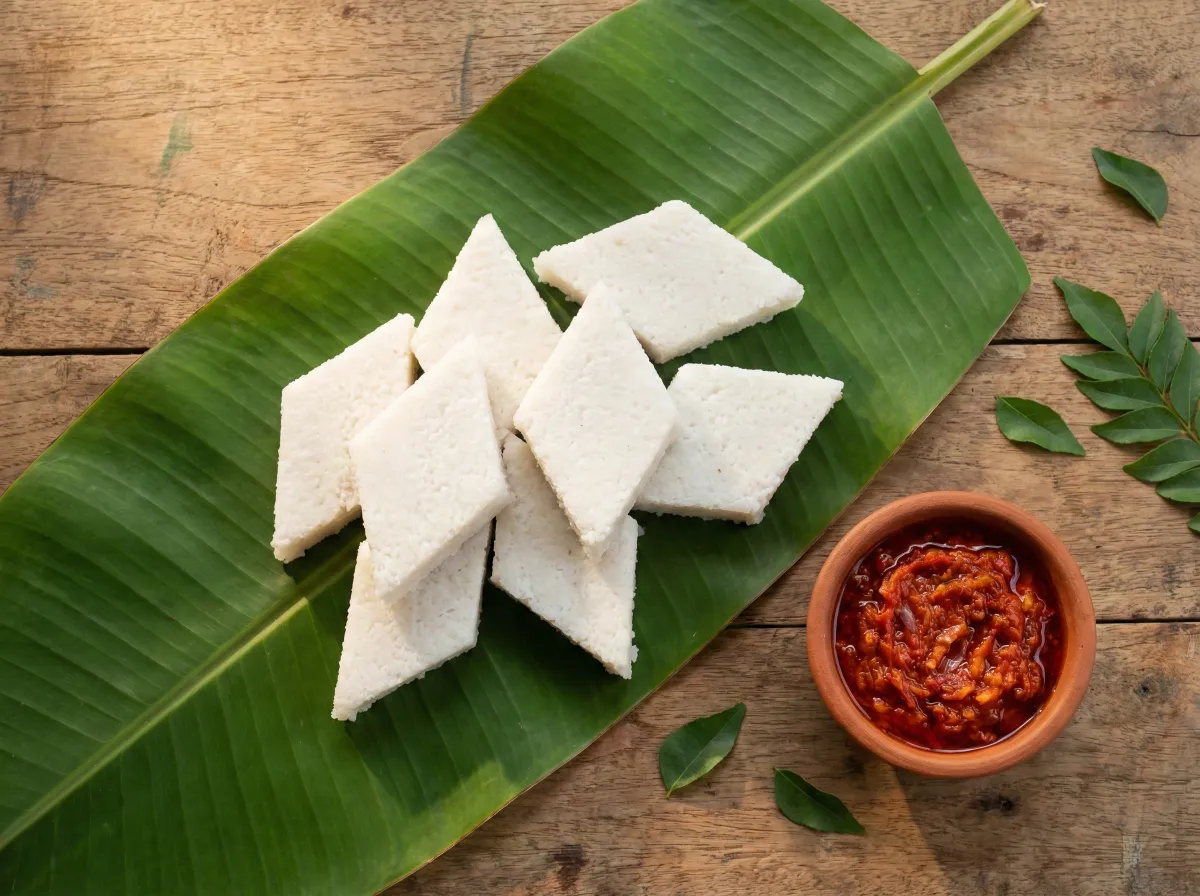
Kiribath (Sri Lankan Milk Rice): The Dish That Marks Every Beginning
Short-grain rice simmered in thick coconut milk until creamy and dense, pressed into a slab, and cut into diamonds — Sri Lanka's most symbolic dish, made simply at home.
Prep
10 min
Cook
30 min
Total
40 min
Serves
6
Ingredients
Milk rice
- 500g short-grain or medium-grain white rice (samba rice is traditional — Japanese sushi rice or risotto rice work well)
- 600ml water
- 400ml thick coconut milk (one full tin — must be full-fat)
- 1 tsp salt
Lunu miris (chilli onion sambol)
- 6–8 dried red chillies (Kashmiri for colour, or any medium-heat variety)
- 1 medium red onion, roughly chopped
- 2 tbsp Maldive fish flakes (or 1 tbsp dried shrimp, pounded)
- 1 tbsp lime juice
- 1/2 tsp salt
- 1/2 tsp black pepper
- 1 small piece goraka or 1/2 tsp tamarind paste (optional)
Method
- 1
Wash the rice in several changes of water until the water runs mostly clear. Drain well.
- 2
Put the rice and 600ml water in a heavy-bottomed pot. Bring to a boil, stir once, then cover tightly and reduce heat to the lowest setting. Cook for 15 minutes until the water is absorbed and the rice is tender. Do not lift the lid during this time.
- 3
Uncover the rice. Pour the full tin of thick coconut milk over the rice. Add the salt. Stir gently with a wooden spoon or rice paddle, folding the coconut milk through the rice — do not mash it.
- 4
Return to low heat, uncovered. Cook for another 8–10 minutes, stirring occasionally, until the coconut milk is fully absorbed and the rice is thick, glossy, and holds together when pressed. It should be noticeably creamier and denser than regular steamed rice.
- 5
While the rice is still hot, transfer it to a flat tray, baking sheet, or banana leaf. Press it firmly with the back of a spoon or a spatula moistened with water into an even layer about 2cm thick. The surface should be smooth and compact.
- 6
Let it cool for 10–15 minutes until it sets firm enough to cut cleanly. Cut into diamond shapes — make parallel cuts diagonally across the slab, then cross them in the opposite direction.
- 7
For the lunu miris: soak the dried chillies in warm water for 10 minutes, then drain. Pound or pulse the chillies, onion, Maldive fish, salt, and pepper together — traditionally in a stone mortar, but a small food processor works. You want a rough, chunky paste, not a smooth sauce. Stir in the lime juice and goraka or tamarind if using. Taste and adjust salt and heat.
- 8
Serve the kiribath diamonds at room temperature with the lunu miris alongside. Each piece is picked up by hand, a dab of sambol placed on top, and eaten in two bites.
A Dish for Firsts
Kiribath is the first food cooked in a new home. It’s the first dish prepared on Sinhala and Tamil New Year morning. It’s made on the first of every month in many Sri Lankan households, and it’s the first solid food offered to a baby. No other dish in the Sri Lankan kitchen carries this weight of ritual and beginning.
And yet the dish itself is almost absurdly simple: rice cooked with coconut milk, pressed flat, cut into diamonds. There is no spice paste, no tempering, no layering of aromatics. The entire recipe rests on two ingredients and the understanding that coconut fat, absorbed fully into starchy rice, creates something greater than the sum of its parts — dense, rich, subtly sweet, and deeply satisfying in a way that’s hard to explain until you’ve eaten it.
If you’ve made our Sri Lankan fish curry or kottu roti, you know that Sri Lankan food can be complex and layered. Kiribath is the opposite — it’s the calm centre of the cuisine, the dish that everything else orbits around.
The Rice Matters
The grain you choose determines whether this works or doesn’t. You need a starchy, short- or medium-grain rice that becomes sticky and cohesive when cooked. Sri Lankans use samba rice — a red or white short-grain variety that clings together naturally. It’s available at Sri Lankan and South Indian groceries.
If you can’t find samba, your best substitutes are:
- Japanese sushi rice — the closest in behaviour. It’s starchy, sticky, and presses into a firm slab exactly the way samba does.
- Arborio or carnaroli (risotto rice) — slightly larger grain but the same high-starch character. Works well.
- Medium-grain white rice — sold generically at most supermarkets. Adequate.
Avoid basmati or any long-grain rice. They cook into separate, fluffy grains that refuse to bind together. You’ll end up with creamy loose rice rather than a sliceable slab, and the whole point of kiribath is the slab.
Coconut Milk: Only Thick
This is not the place for light coconut milk. Kiribath requires the thick, full-fat first pressing — the kind that comes out of the tin with a solid cream layer on top. That fat is doing structural work: it saturates the rice starch, binding the grains together and creating the dense, almost pudding-like texture that allows kiribath to be cut into clean shapes.
One standard 400ml tin is the right amount for 500g of rice. Some recipes call for more, but you want the coconut milk fully absorbed, not pooling at the bottom of the pot. The finished rice should be glossy and cohesive, not soupy.
Shake the tin well before opening, or stir the cream and liquid together before adding. You want an even emulsion going into the rice.
The Press
Getting kiribath from a pot of creamy rice to a tray of neat diamonds requires one thing: pressing it firmly while it’s still hot. The rice sets as it cools, so you have a window of about five minutes after transferring it to a tray.
Wet the back of your spoon or spatula — this prevents sticking — and press down firmly and evenly. The layer should be about 2cm thick. Thinner and it crumbles; thicker and the pieces are too heavy and dense. Smooth the surface.
A banana leaf on the tray is traditional and makes the presentation beautiful, but it’s not required. Parchment paper or a lightly oiled tray works fine.
Let it sit uncovered at room temperature. After 10–15 minutes, the slab will be firm enough to cut. Use a sharp knife dipped in water for clean cuts. The diamond shape is traditional — diagonal parallel cuts in one direction, then crossed in the other — but squares work too.
Lunu Miris: The Essential Partner
Kiribath without lunu miris is like bread without anything. The rice is mild, rich, and subtly sweet. The sambol is sharp, salty, searingly hot, and pungent with dried fish and lime. The contrast is the point.
Lunu miris is made by pounding — traditionally in a miris gala, the flat stone mortar found in every Sri Lankan kitchen. The rough stone tears the chillies and onion into a coarse, uneven paste where some pieces are crushed fine and others remain chunky. A food processor gets you close, but pulse carefully — you want a rough relish, not a smooth chutney.
Maldive fish (umbalakada) is the ingredient that gives lunu miris its distinctive savoury depth. These are small dried tuna pieces, hard as wood, with an intense umami flavour. They’re sold at Sri Lankan groceries and keep indefinitely in a sealed jar. If you can’t find them, dried shrimp pounded to a rough powder is the closest substitute. Skipping the dried fish entirely leaves the sambol one-dimensional — just hot and sour — so try to include it.
When to Make It
Kiribath is traditionally a morning dish — it’s breakfast food and celebration food, not dinner. Sri Lankans eat it:
- Sinhala and Tamil New Year (April 14) — the most important occasion. The first pot of kiribath is cooked at an auspicious time determined by astrologers.
- The first of every month — a quiet domestic ritual in many families, marking a fresh start.
- Birthdays, weddings, housewarmings — any beginning worth marking.
- Any regular morning — with a cup of strong Ceylon tea on the side.
It’s always served at room temperature, never hot. The cooling and setting is part of the dish, not a compromise.
Variations
- Kalu dodol pairing: On New Year, kiribath is often served alongside kalu dodol — a dense, dark coconut jaggery sweet. The combination of the mild milk rice with the treacly sweetness is traditional.
- With jaggery: Some families skip the sambol for children and serve kiribath with a drizzle of kithul treacle (palm jaggery syrup) or a piece of jaggery on the side. Sweet kiribath is breakfast comfort food.
- Savoury toppings: Beyond lunu miris, kiribath pairs well with any Sri Lankan sambol — pol sambol (coconut relish), seeni sambol (caramelised onion), or a spoonful of leftover fish curry sauce.
- Imbul kiribath: A filled version where the milk rice is rolled around a sweetened coconut filling. This is a celebratory sweet, more elaborate and rich.