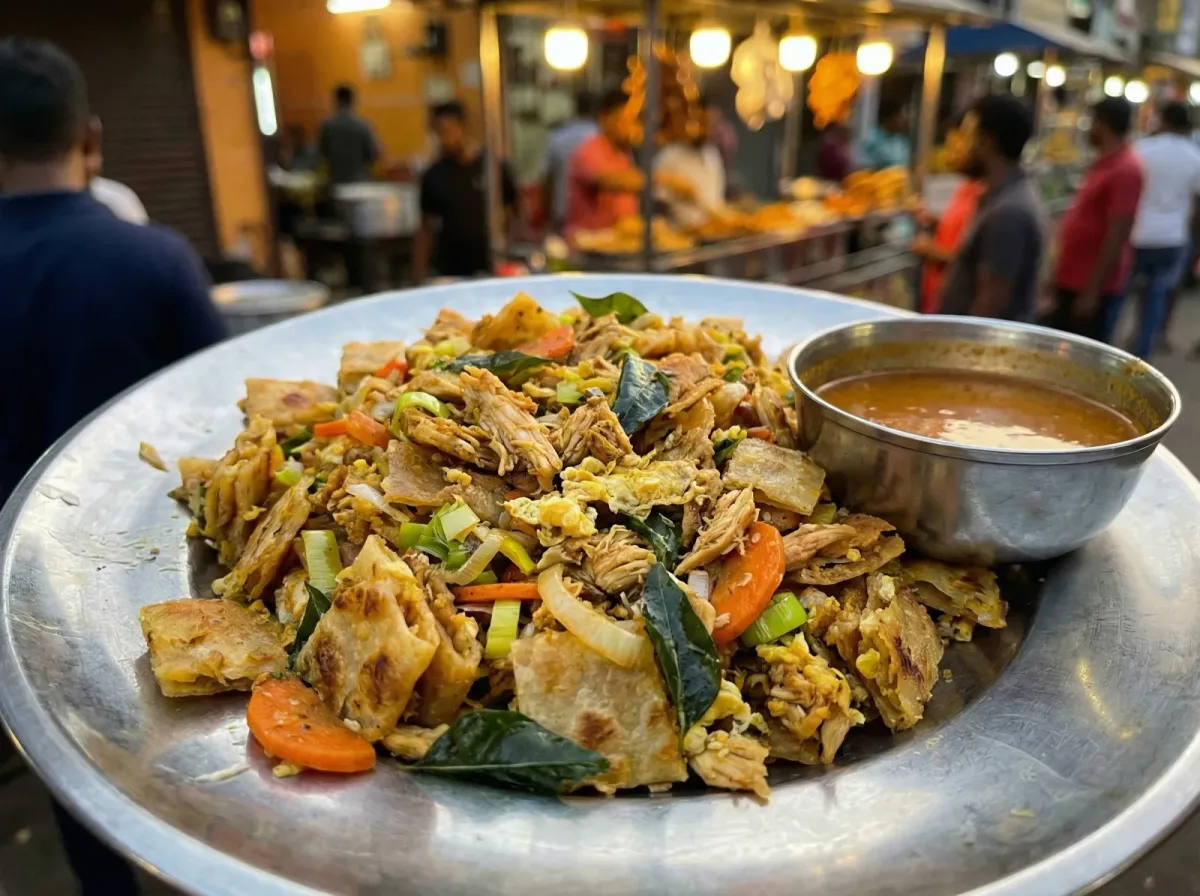
Kottu Roti at Home: Sri Lanka's Most Iconic Street Food
Torn godamba roti chopped on a hot griddle with egg, vegetables, and spices — Sri Lanka's noisiest, most addictive street food, made properly at home.
Prep
30 min
Cook
20 min
Total
50 min
Serves
4
Ingredients
Godamba roti (makes 8)
- 300g plain flour
- 1/2 tsp salt
- 1 tbsp coconut oil or vegetable oil
- 1 egg, beaten (optional — for a richer, more pliable dough)
- 180ml warm water (reduce to 150ml if using egg)
- Extra coconut oil or vegetable oil for resting and cooking
Kottu base
- 4 godamba roti (store-bought parotta or homemade, see above), torn into rough strips
- 3 tbsp vegetable oil
- 2 eggs, beaten
- 1 large onion, finely sliced
- 2 green chillies, finely chopped
- 1 large leek, washed and finely sliced (white and light green parts)
- 1 medium carrot, cut into thin matchsticks
- 100g cabbage, finely shredded
- 2 sprigs fresh curry leaves (about 20 leaves)
- 3 cloves garlic, finely chopped
- 1-inch piece ginger, finely chopped
Spices
- 1 tsp Sri Lankan roasted curry powder
- 1/2 tsp chilli flakes or chilli powder
- 1/2 tsp turmeric
- 1/2 tsp black pepper
- 1 tbsp soy sauce
- 1 tbsp Sri Lankan chilli sauce or sriracha
- Salt to taste
Chicken version (optional)
- 250g boneless chicken thigh, cut into small pieces
- 1/2 tsp turmeric
- 1/2 tsp chilli powder
- 1/4 tsp salt
- 1 tbsp oil for cooking
Curry sauce (for serving)
- 200ml coconut milk
- 1 tbsp Sri Lankan curry powder
- 1 small onion, finely chopped
- 2 cloves garlic, sliced
- 1 sprig curry leaves
- 1/2 tsp turmeric
- Salt to taste
Method
- 1
If making godamba roti from scratch: mix flour, salt, oil, and beaten egg (if using) with warm water into a soft, slightly sticky dough. Knead for 8–10 minutes until smooth and elastic. Divide into 8 balls, coat generously with oil, cover, and rest for at least 2 hours — overnight in the fridge is ideal.
- 2
To cook the roti: stretch each ball as thin as possible on an oiled surface (it should be nearly translucent). Cook on a hot dry tawa for 30–40 seconds per side until blistered and cooked through but still pliable. Stack and cover. You only need 4 for the kottu — freeze the rest.
- 3
If using chicken: season the pieces with turmeric, chilli powder, and salt. Fry in 1 tbsp oil over high heat until cooked through and lightly charred, about 5–6 minutes. Set aside.
- 4
Make the curry sauce: fry onion, garlic, and curry leaves in a little oil until softened. Add curry powder and turmeric, cook for 1 minute. Pour in coconut milk, season with salt, and simmer for 10 minutes until slightly thickened. Keep warm.
- 5
Tear the roti into rough strips, approximately 2cm wide and 5cm long. They don't need to be uniform.
- 6
Heat a large flat griddle, tawa, or your widest heavy pan over high heat. Add 3 tbsp oil. When smoking, add the curry leaves — they will crackle and spit.
- 7
Add garlic and ginger, stir for 15 seconds. Add onion, leek, carrot, cabbage, and green chillies. Stir-fry over high heat for 2–3 minutes. The vegetables should wilt but retain some bite.
- 8
Push the vegetables to one side. Pour in the beaten eggs on the cleared surface. Scramble roughly with your spatula, breaking into small pieces as they set.
- 9
Add all the spices, soy sauce, and chilli sauce. Toss everything together.
- 10
Add the torn roti strips and the cooked chicken (if using). Now chop and toss aggressively with the edge of two metal spatulas or a heavy cleaver, combining everything on the hot surface. This is the kottu technique — the rhythmic chopping is how it's done on the streets. Continue for 2–3 minutes, scraping the bottom to get some charred, crispy bits.
- 11
Taste and adjust salt and chilli. Serve immediately on a metal plate with the curry sauce on the side for pouring.
The Sound of Kottu
Spelled kottu in English transliterations but often written kothu by Sri Lankans themselves — both refer to the same dish. Before you taste it, you hear it. The rhythmic clang of two metal cleavers chopping roti on a flat griddle is the signature sound of Sri Lankan street food stalls after dark. It’s a performance as much as a cooking technique — the speed and rhythm of the chopping tells you everything about the cook’s skill.
At home, you won’t match the sound (your neighbours will thank you), but the technique matters: you need to aggressively chop and toss the roti strips with the vegetables and egg on a very hot surface. This creates the mix of textures — some roti pieces soft and sauce-soaked, others charred and crispy at the edges — that defines great kottu.
The Roti Question
Authentic kottu uses godamba roti — a thin, stretchy, oil-enriched flatbread similar to Malaysian roti canai or South Indian parotta. We have a full recipe for it, but it requires resting time.
Your alternatives, in order of authenticity:
- Frozen parotta from a South Asian grocery (the best shortcut — these are almost identical to godamba roti)
- Leftover roti or chapati — different texture, but works
- Flour tortillas — surprisingly close in behaviour on a griddle
The roti should be cooked and cooled before you start the kottu. Leftover roti that’s been sitting out for a few hours (or overnight in the fridge) is actually ideal — the slight drying makes it hold up better during the aggressive chopping.
Sri Lankan Curry Powder
This is different from Indian or Pakistani garam masala. Sri Lankan curry powder is roasted — the whole spices are dry-roasted until very dark before grinding, giving the powder a smoky, almost coffee-like depth.
If you can’t find it, you can approximate it: dry-roast 2 tbsp coriander seeds, 1 tbsp cumin seeds, 1 tsp fennel seeds, 5cm piece cinnamon, 6 cloves, and 4 cardamom pods over medium heat until they’re noticeably darker and very fragrant — almost on the edge of burning. Cool and grind. Add 1/2 tsp fenugreek powder and a few dried curry leaves ground to powder.
The Curry Sauce
Kottu is not complete without the small bowl of thin curry sauce served alongside. You pour it over the kottu at the table — it moistens the drier pieces and ties everything together. It’s essentially a quick coconut-milk curry with no solids, and it takes 10 minutes to make.
Don’t skip it. Kottu without the sauce is like chips without anything — technically fine, but missing the point.
Variations
- Egg kottu: No meat, extra eggs scrambled through
- Cheese kottu: A modern Colombo invention — processed cheese slices melted through at the end. Sounds wrong. Tastes excellent.
- Seafood kottu: Prawns or cuttlefish, common in coastal areas. If you have leftover Sri Lankan fish curry, shred the fish through the kottu instead of chicken.
- Vegetable kottu: Skip the meat, double the vegetables, add firm tofu if you want protein
The technique stays the same regardless of filling. High heat, aggressive chopping, serve fast.