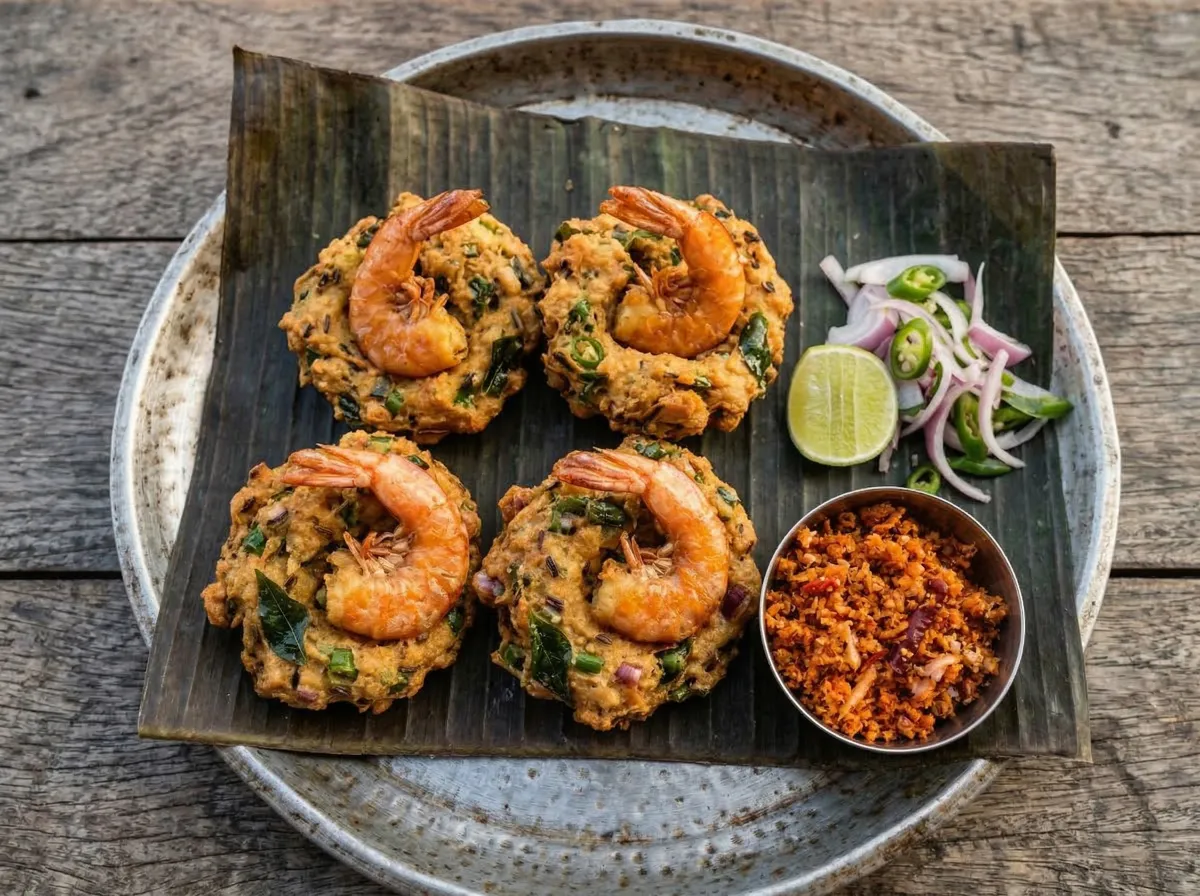
Isso Vadai: Sri Lanka's Crispy Prawn-Topped Street Fritters
Crispy lentil fritters crowned with whole prawns and deep-fried until golden — Sri Lanka's most iconic street snack, born from South Indian tradition and transformed by island ingenuity.
Prep
20 min
Cook
25 min
Total
45 min
Serves
12
Ingredients
Vadai base
- 200g chana dal (split chickpeas), soaked for at least 6 hours (or overnight)
- 1 medium red onion, finely chopped
- 4–5 fresh curry leaves, finely chopped
- 2 green chillies, finely chopped
- 1 tsp ginger paste
- 1 tsp garlic paste
- ½ tsp turmeric powder
- ½ tsp chilli powder (adjust to taste)
- 3–4 tbsp scraped or rehydrated desiccated coconut
- ½ tsp fennel seeds (optional but common)
- Pinch ground cumin (optional)
- 1 tsp salt
- 2 tbsp rice flour (helps bind — see notes)
- Coconut oil for deep frying (see notes)
Prawns
- 40–60 small prawns, shell-on, tails left intact (about 3–4 per vadai)
- ½ tsp turmeric powder
- ½ tsp chilli powder
- ½ tsp salt
- 1 tbsp lime juice
Pol sambol (serving)
- 1 cup fresh grated coconut (or desiccated, rehydrated)
- 1 small red onion, finely chopped
- 1–2 green chillies, finely chopped
- 1 tbsp Maldive fish flakes (optional)
- 1 tbsp lime juice
- ½ tsp salt
Method
- 1
Drain the soaked dal thoroughly (chana dal, in this version). Transfer to a food processor or wet grinder and grind to a coarse, thick paste — not smooth. You want some texture remaining, like coarse sand. Add 1–2 tablespoons of water only if absolutely necessary; the batter should be thick enough to hold its shape, not pourable.
- 2
Transfer the ground dal to a large bowl. Add the coconut, fennel seeds, pinch of cumin (if using), chopped onion, curry leaves, green chillies, ginger paste, garlic paste, turmeric, chilli powder, salt, and rice flour. Mix well with your hands, squeezing the mixture together. The batter should be stiff and hold together when shaped — if it feels too loose, add another tablespoon of rice flour.
- 3
Prepare the prawns: rinse and pat completely dry. Mix the turmeric, chilli powder, salt, and lime juice in a small bowl, then toss the prawns to coat evenly. Set aside to marinate for 15 minutes while you prepare the sambol.
- 4
Make the pol sambol: combine the grated coconut, chopped onion, green chillies, Maldive fish flakes (if using), lime juice, and salt in a bowl. Mix well and taste — it should be bright, salty, and sharp. Set aside.
- 5
Heat coconut oil in a deep pan or wok to 170°C (340°F). To test, drop a small piece of batter in — it should sink briefly then rise to the surface with steady bubbles, not violent spluttering.
- 6
Wet your hands to prevent sticking. Take a golf-ball-sized portion of batter and flatten it into a patty about ½cm thick and 5–6cm wide. Press 3–4 marinated prawns firmly into the centre of the patty, tails pointing outward — the batter should hold them in place. Repeat with remaining batter and prawns.
- 7
Carefully slide 2–3 vadai at a time into the hot oil, prawn-side up. Fry for 2–4 minutes per side until deep golden brown and crispy. The prawns will curl and turn orange as they cook. Do not overcrowd the pan — the temperature will drop and the vadai will absorb oil.
- 8
Remove with a slotted spoon and drain on paper towels. Serve hot with pol sambol on the side, or for a more beach-stall feel use a simple raw onion-tomato sambol (finely chopped onion, tomato, green chilli, and lime juice). Eat immediately — isso vadai lose their crispness as they cool.
The Snack That Unites an Island
Walk along Galle Face promenade in Colombo as the sun sets, and you’ll see them everywhere — golden discs sizzling in large woks, pulled out by the dozen, stacked on paper plates and handed over for a few rupees. Isso vadai (isso = prawn, vadai = patty) is Sri Lanka’s most democratic street food. Vendors sell them at beaches, train stations, bus stands, and school gates, and the queue is always mixed: office workers, schoolchildren, tourists, families. At Rs 50–70 a piece (about 15–20 pence), anyone can afford one.
The dish has roots in South India, where lentil fritters — variously called vadai, vada or parippu vade — have been eaten for centuries. South Indian labourers brought these plain lentil patties to Sri Lanka during British colonial rule (1796–1948), and many of their descendants in the Hill Country still make them without seafood. The now-iconic topping of prawns seems to have emerged later as a specifically Sri Lankan twist — most likely where plantation communities, coastal markets, and urban street vendors intersected — so the story is less a single “coastal adaptation” and more a gradual layering of prawns onto an existing immigrant snack.
If you’ve made our kottu roti or godamba roti, you know Sri Lankan street food is bold, loud, and unapologetic. Isso vadai fits right in — crispy, hot, salty, with a sweet prawn perched on top like a crown.
Two Elements, One Fritter
Isso vadai is really two preparations combined: a lentil fritter base and a prawn topping. Both need to be right for the dish to work.
The lentil base is made from chana dal (split chickpeas) in this version — a choice that matches many Sri Lankan home and street recipes. Many street versions also use urad dal (ulunthu) for a slightly springier, more “vadai” texture. Some cooks use masoor dal (red lentils) too, but the texture is critical either way: too smooth and the vadai becomes dense and cakey; too coarse and it falls apart in the oil. You want a mixture that feels like damp breadcrumbs when squeezed, holding together but with visible bits of dal throughout.
The prawn is pressed into the flattened batter just before frying. It’s not mixed in — it sits on top, partially submerged, so that when the vadai hits the oil, the prawns curl and cook in the same motion as the lentils crisp. Keep the tail left on for visual effect and as a built-in handle.
The Prawns Matter
On the street in Colombo, you’ll most often see several small prawns perched on a single vadai, shells and tails left on, curled together in a little cluster. It’s visual theatre as much as anything — a way to show you’re getting real seafood on your snack.
At home, you can do either: this recipe aims for the street look with 3–4 small prawns per vadai, but you can also use one larger prawn if that’s what you have. Either approach works — the key is timing so the prawns cook through while the lentil base stays crisp.
Whichever size you choose, leave the shells on the body but remove the vein if needed. The shell protects the meat during frying and helps the prawns hold their shape. The tail is left intact — it’s the handle, and it’s the signature look of a proper isso vadai.
Marinate the prawns briefly in turmeric, chilli powder, salt, and lime juice. This isn’t just seasoning — the turmeric gives the prawns that vivid orange colour, and the acid starts breaking down the proteins so they cook faster and stay tender. Fifteen minutes is enough.
The Batter Consistency
Getting the vadai batter right is the hardest part of this recipe. The mixture needs to be thick and stiff, not soft or sticky.
After grinding the soaked dal, pick up a handful and squeeze it. It should hold together in a firm clump without oozing through your fingers. If it feels wet or loose, add rice flour a tablespoon at a time until it firms up. The coconut in the batter adds subtle sweetness and helps with crispness, but it can also loosen the mix if your dal was soaked too wet — so adjust with rice flour if needed. The rice flour acts as the main binder — it absorbs excess moisture and helps the vadai hold its shape in the oil.
Don’t be tempted to add water to make grinding easier. The dal should grind using only the moisture it absorbed during soaking. Wet batter makes greasy, heavy vadai that don’t crisp properly.
The additions — onion, curry leaves, green chillies, ginger, garlic — should be chopped fine and mixed in by hand, squeezing the batter to distribute them evenly. Add the fennel seeds (and a pinch of cumin if you like) for that street-fry aroma. This is also when you taste for salt. Fry a tiny test piece first if you’re unsure.
Frying Technique
The oil temperature is crucial. Too hot and the exterior burns before the prawn cooks through; too cool and the vadai absorbs oil and becomes heavy.
The right temperature is 170°C (340°F) — hot enough that the vadai sizzles immediately but doesn’t brown too fast. If you’re using coconut oil, keep an eye on the heat: it browns faster than some neutral oils. If you don’t have a thermometer, test with a small piece of batter: it should sink briefly, then rise to the surface with steady, gentle bubbles. Violent, noisy sputtering means the oil is too hot.
Fry 2–3 vadai at a time, no more. Overcrowding drops the temperature and the vadai will be greasy. Flip once, halfway through, so both sides cook evenly. The total frying time is 6–8 minutes — the vadai should be a deep golden brown, not pale yellow.
Drain on paper towels and serve immediately. Isso vadai are best eaten hot, when the exterior is still shatteringly crisp. As they cool, the moisture from the prawn softens the lentil base. They’re still good at room temperature, but they’ve lost their peak.
The Sambol Accompaniment
Isso vadai are rarely eaten alone. At street stalls, they most commonly come with a simple raw sambol of finely chopped onion, tomato, green chilli, and lime juice — sometimes with a little salt and chilli powder rubbed in with the fingers. This is bright, fresh, and fast to make between batches of fritters.
At home, many Sri Lankans serve isso vadai with pol sambol — a richer coconut-based relish with onion, green chilli, lime, and sometimes Maldive fish (dried tuna flakes). It’s closer to what you’ll find alongside pittu, and it turns isso vadai into more of a substantial snack or starter.
Whichever sambol you choose, the combination is essential. A plain isso vadai is tasty but one-dimensional. With sambol, it becomes a complete bite: crispy, soft, sweet, salty, sharp, hot.
When to Make Them
In Sri Lanka, isso vadai is an afternoon and evening snack — the kind of thing you buy from a cart on the way home from work or school. It’s not breakfast food, not dinner. It’s a between-meal bite, often eaten with a cup of strong tea.
They’re particularly associated with Galle Face and other seaside promenades, where vendors set up in the late afternoon and fry continuously until well after dark. The sea breeze, the sound of sizzling oil, and the smell of frying lentils and prawns are part of the experience.
At home, make them for a snack spread, a party appetiser, or a weekend project. They’re labour-intensive enough to feel special but straightforward enough that anyone can do it with a little practice.
Variations
- Parippu vade (plain lentil fritter): Skip the prawns entirely. Shape the lentil mixture into flat patties and fry. This is the plain version that underpins isso vadai and is still eaten on its own across Sri Lanka, especially in Hill Country communities.
- Urad dal vadai base: Use urad dal (black gram/ulunthu) instead of chana dal for a more classic Sri Lankan prawn vadai texture.
- Mixed seafood: Some coastal variations use small whole fish or squid rings in place of prawns. Less common but delicious.
- Baked version: For a lighter alternative, brush the shaped vadai with oil and bake at 200°C (400°F) for 15–20 minutes, flipping once. The texture is different — less crisp, more cakey — but it works.
- With seeni sambol: Instead of pol sambol, serve with seeni sambol (caramelised onion relish). The sweetness plays beautifully against the savoury prawn.