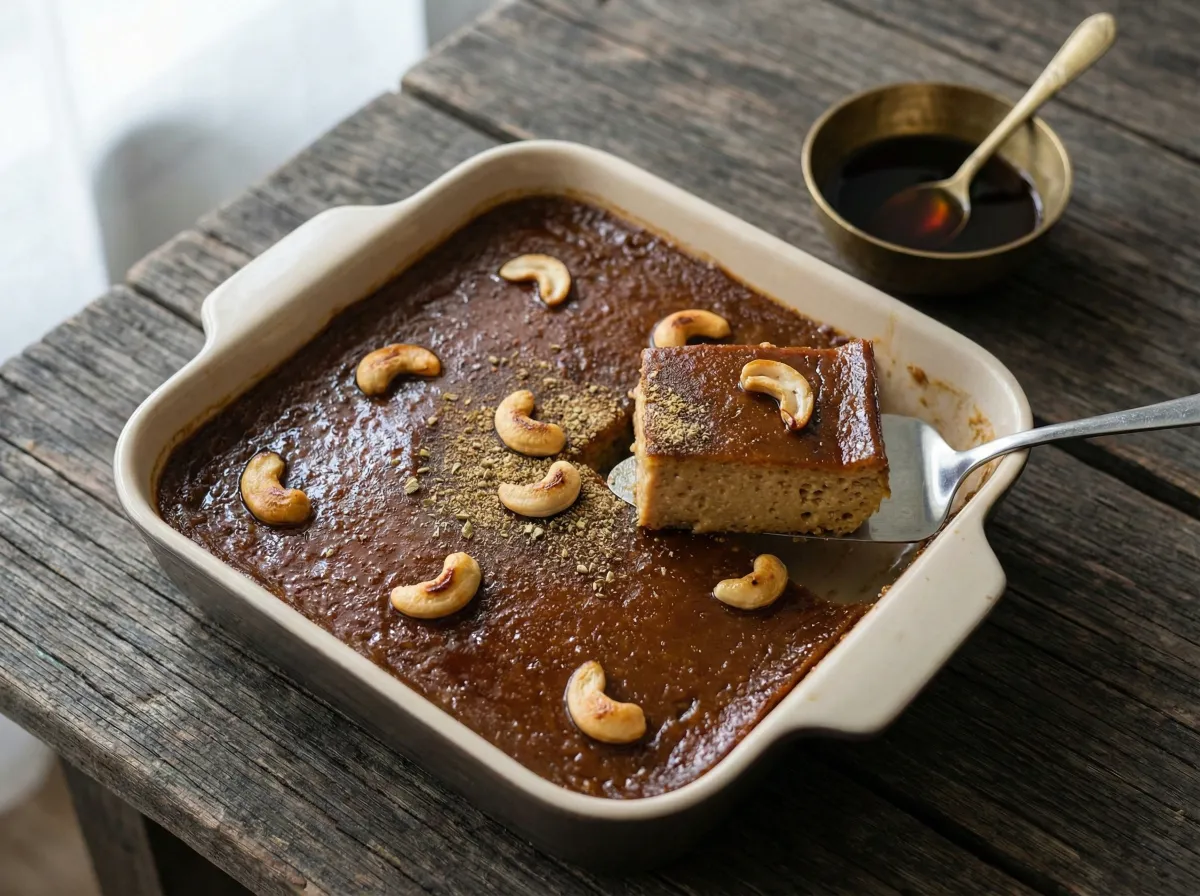
Watalappan: Sri Lanka's Spiced Coconut Jaggery Custard
A steamed custard of coconut milk, kithul jaggery, and warm spices — Sri Lanka's Malay-influenced dessert, rich and caramel-dark, topped with roasted cashews.
Prep
15 min
Cook
60 min
Total
75 min
Serves
8
Ingredients
Custard
- 4 large eggs plus 2 egg yolks
- 250g kithul jaggery, grated or broken into small pieces (or palm jaggery — see notes)
- 500ml thick coconut milk (full-fat, about 1¼ tins)
- ½ tsp ground cardamom (about 6 pods worth)
- ¼ tsp ground nutmeg, freshly grated
- ¼ tsp ground cloves
- 1 tsp pure vanilla extract
- pinch of salt
Garnish
- 2 tbsp raw cashew halves, dry-roasted until golden
- extra jaggery syrup for drizzling (optional)
Method
- 1
Preheat the oven to 160°C (320°F) conventional, or 140°C fan-forced. Lightly grease a 23cm square baking dish or six to eight individual ramekins with a thin film of coconut oil.
- 2
Combine the jaggery and 60ml (¼ cup) water in a small saucepan over medium heat. Stir until the jaggery is fully dissolved and you have a smooth, dark syrup with no lumps — about 3–4 minutes. If using very hard block jaggery, break it up first and give it a few extra minutes. Set aside to cool for 10 minutes. The syrup must not be hot when it meets the eggs.
- 3
In a large bowl, whisk the eggs and egg yolks together gently — just enough to break them up and combine whites and yolks into a uniform mixture. You do not want to whip air in; an airy batter creates an uneven, bubbly custard. A fork or gentle hand whisk is better than a stand mixer here.
- 4
Add the coconut milk to the eggs and whisk until evenly combined. Then pour in the cooled jaggery syrup in a thin, steady stream, whisking constantly to temper the eggs. Stir in the cardamom, nutmeg, cloves, vanilla, and salt.
- 5
Strain the mixture through a fine-mesh sieve into the prepared dish. This removes any chalky jaggery sediment, stray shell fragments, and spice clumps. Press gently through with a spoon — don't skip this step, it's the difference between a silky custard and a grainy one.
- 6
Cover the dish tightly with aluminium foil. Place it inside a larger roasting pan and pour hot water into the roasting pan until it reaches about two-thirds up the side of the custard dish. This water bath (bain-marie) ensures the custard cooks gently and evenly.
- 7
Bake for 45–60 minutes. The custard is done when the edges are set and the centre still has a slight wobble — it will firm up as it cools. A toothpick inserted near the centre should come out clean with no liquid egg. If the centre is still clearly liquid after 60 minutes, give it another 10 minutes and check again.
- 8
Remove the custard dish from the water bath and let it cool on a wire rack for 15 minutes. Then cover with cling film and refrigerate for at least 3–4 hours, ideally overnight. Watalappan is always served cold — it firms, the jaggery flavour deepens, and the spices mellow with chilling.
- 9
To serve, scatter roasted cashew halves over the top and cut into squares or wedges. Drizzle with a little extra jaggery syrup if you like. Serve straight from the dish.
A Custard Between Two Worlds
Watalappan is Sri Lanka’s most beloved dessert, and it arrived from somewhere else. The dish traces back to the Sri Lankan Malay community — descendants of soldiers, merchants, and political exiles from the Malay Archipelago who settled on the island from the 17th century onward. They brought with them a steamed coconut egg custard called srikaya, and over generations it evolved into something distinctly Sri Lankan: darker, spicier, scented with cardamom and cloves instead of pandan, and sweetened with kithul jaggery instead of white sugar.
The Malay origins are right there in the name — watalappan likely derives from a Malay word — but today the dish belongs to the whole island. It’s the standard dessert at Muslim celebrations, particularly Ramadan iftar, where it appears on nearly every table. But it’s also made by Sinhalese and Tamil families for weddings, birthdays, and any occasion that calls for something sweet and impressive that isn’t a Western-style cake.
If you’ve made our kiribath, you know that Sri Lankan ceremonial food tends to be simple in technique and profound in meaning. Watalappan follows the same logic: it’s just eggs, coconut milk, jaggery, and spice. No flour, no starch, no gelatine. The custard sets from eggs alone, and the flavour comes entirely from the quality of the jaggery and the warmth of the spices.
Jaggery: The Heart of It
The defining ingredient is kithul jaggery — unrefined sugar made from the sap of the kithul palm (Caryota urens), tapped and boiled down to a dark, smoky block. It tastes nothing like white sugar or even brown sugar. Kithul jaggery has notes of toffee, burnt caramel, and a faintly mineral earthiness that gives watalappan its characteristic depth.
If you can find kithul jaggery at a Sri Lankan grocery, use it. There is no perfect substitute, but here’s what comes closest:
- Palm jaggery (from palmyra or coconut palm) — widely available at Indian groceries. Slightly less complex than kithul but produces a very good watalappan.
- Gur / Indian jaggery (from sugarcane) — common and affordable. Sweeter and lighter in colour. The custard will taste more like caramel than toffee, but it works.
- Dark muscovado sugar — use as a last resort. It has some of the molasses depth but lacks the palm character entirely.
Avoid light brown sugar, coconut sugar, or maple syrup. They don’t have the intensity needed and the custard will taste thin.
Jaggery comes in different forms — hard blocks, soft cakes, or grated. Hard blocks need to be broken up with a heavy knife or grated before dissolving. Soft jaggery melts readily. Either works, just make sure it dissolves completely with no lumps before it goes into the egg mixture.
The Egg Question
Watalappan is an egg custard, and the eggs are doing all the structural work — there’s no flour or starch to help. This means the ratio of eggs to liquid matters, and how you handle them matters more.
Don’t over-whisk. You want the eggs gently combined, not aerated. Air bubbles in the batter create a spongy, pockmarked custard instead of a smooth, dense one. Use a fork or a gentle hand whisk. If you see froth on the surface after mixing, let it settle or skim it off before pouring into the dish.
Temper carefully. The jaggery syrup must be cooled before it meets the eggs. If you pour hot syrup into raw eggs, you’ll get sweet scrambled eggs. Let the syrup cool until you can comfortably touch the side of the pan, then add it to the eggs in a thin stream while whisking constantly.
Strain always. Even if you think your mixture is perfectly smooth, strain it. Jaggery often has tiny granules and bits of fibre that don’t fully dissolve. One pass through a fine sieve guarantees a silky result.
Steaming vs. Baking
Traditionally, watalappan is steamed — the custard dish is placed inside a large pot with a rack or trivet, water is added to below the dish level, and it’s covered and steamed on the stovetop for 45–60 minutes. This is still the method used in most Sri Lankan homes.
The recipe above uses oven baking in a water bath, which produces the same result with less fiddling. The water bath replicates the gentle, moist heat of steaming. If you prefer to steam:
- Set a trivet or small inverted plate in the bottom of a large pot.
- Place the covered custard dish on the trivet.
- Add hot water to reach halfway up the custard dish.
- Cover the pot with a lid wrapped in a tea towel (to catch condensation and prevent drips).
- Steam over medium-low heat for 50–60 minutes.
Either method works. The key is gentle, indirect heat. Direct high heat causes the custard to curdle and develop tunnels.
Getting the Set Right
The most common mistake is overbaking. A properly set watalappan should wobble in the centre when you gently shake the dish — like a firm jelly, not a liquid. It will continue to set as it cools and will be fully firm after refrigeration.
If you overbake it, the eggs curdle and the custard becomes grainy with tiny holes throughout, weeping liquid. This is still edible — it just won’t have the smooth, creamy texture you’re after. Err on the side of under-done; you can always put it back in the oven, but you can’t un-curdle it.
Serving
Watalappan is always served cold, never warm. The chilling time isn’t optional — the custard needs those hours in the fridge to fully set, for the flavours to meld, and for the jaggery sweetness to deepen. An overnight rest is ideal.
Scatter roasted cashews over the top just before serving. Some people drizzle extra jaggery syrup over each portion — a nice touch if you like it sweeter. A few serve it with a small spoonful of thick coconut cream on the side, which adds richness but isn’t traditional.
Cut it into squares if you’ve made it in a slab, or serve the ramekins as-is. It’s a rich dessert — small portions are right.
Variations
- Individual ramekins: Pour the mixture into 6–8 small ramekins instead of one large dish. Reduce baking time to 30–40 minutes. Check early.
- Pandan watalappan: A nod to the dish’s Malay roots. Infuse the coconut milk with 2–3 pandan leaves (heated gently then strained out) before combining with the eggs. Adds a floral, vanilla-like note.
- Cashew-studded: Some cooks fold roughly chopped cashews into the batter before baking rather than just garnishing the top. The nuts soften slightly and add texture throughout.
- Richer version: Replace the 2 egg yolks with 2 more whole eggs (6 total) for a denser, more firmly set custard. This is common in recipes intended for slicing and serving on a plate rather than eating from a dish.