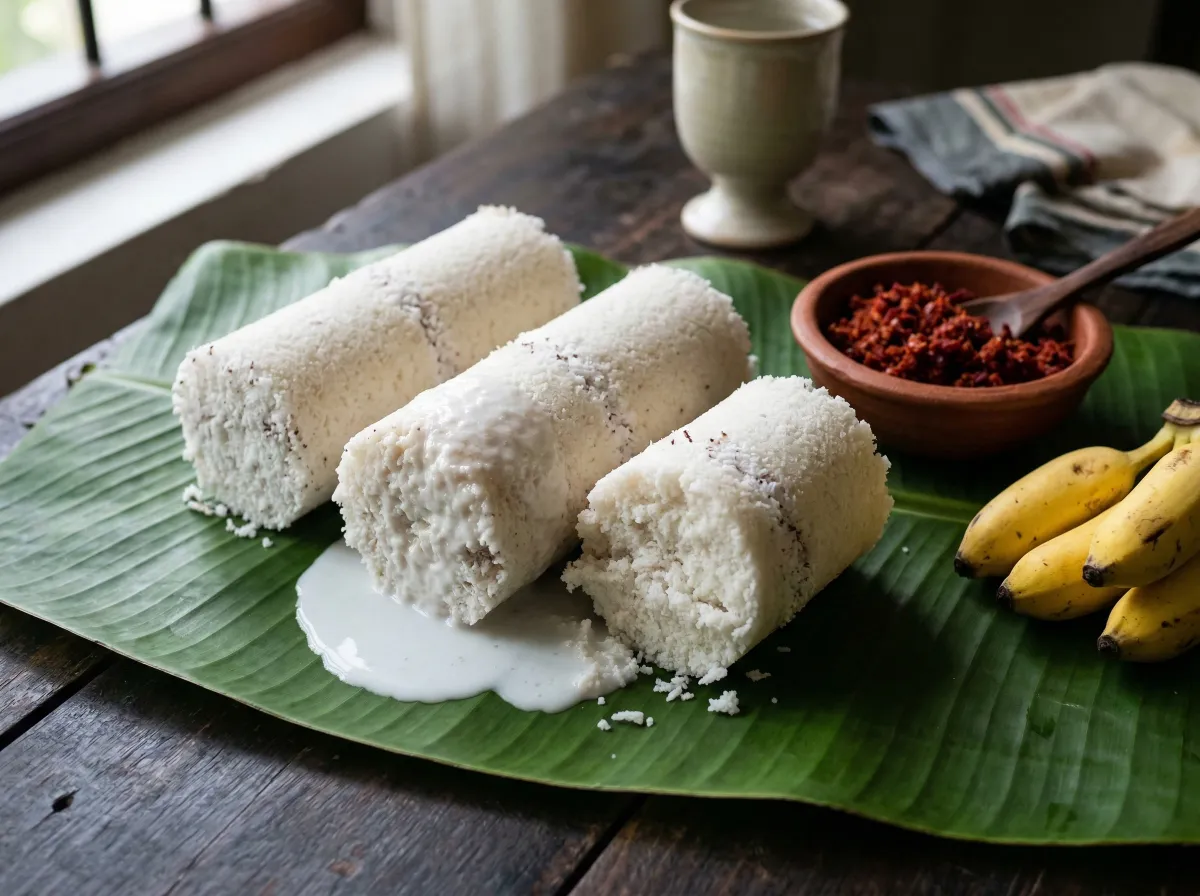
Pittu: Sri Lanka's Steamed Rice and Coconut Cylinders
Crumbled rice flour and fresh grated coconut packed into a cylindrical mold and steamed until soft — Sri Lanka's everyday breakfast, served with coconut milk and curry.
Prep
15 min
Cook
15 min
Total
30 min
Serves
4
Ingredients
Pittu
- 300g raw rice flour (see notes — not glutinous rice flour)
- 150g freshly grated coconut (or desiccated, rehydrated — see notes)
- 1 tsp salt
- 100–120ml water, at room temperature
To serve
- 250ml coconut milk (full-fat, from one tin, shaken well)
- pol sambol (fresh coconut sambol — see notes)
- dhal curry, fish curry, or chicken curry alongside
- 1 ripe banana, sliced (optional — see notes)
Method
- 1
Dry-roast the rice flour in a wide pan over medium heat, stirring constantly, for 4–5 minutes. The flour should become fragrant and very slightly off-white — it doesn't need to colour. This drives off residual moisture and gives the pittu a lighter, non-gummy texture. Remove from heat and cool for a few minutes before proceeding.
- 2
Combine the roasted rice flour and salt in a large wide bowl. Sprinkle the water in small additions — about 2 tablespoons at a time — rubbing the flour between your palms as you go. You are not making a dough. The moistened flour should feel like damp breadcrumbs: it holds its shape when squeezed in a fist, but crumbles apart when pressed lightly with one finger. Add water gradually and stop as soon as you reach this consistency.
- 3
Sieve the moistened flour through a coarse sieve or rub it through your fingers to break up any clumps into a uniform fine crumble. This ensures even steaming throughout the mold.
- 4
Set up your steamer: fill the base pot with water and bring to a vigorous boil. If using a pittu bambu (traditional cylindrical mold), fit it onto the steam vent of the pot or pressure cooker. If you don't have one, use a regular steamer basket or bamboo steamer — see the notes below.
- 5
Fill the pittu bambu in alternating layers: begin with a thin layer of grated coconut (about 1cm thick), then a layer of rice flour crumble (about 2cm thick), then coconut, then flour, ending with a thin coconut layer on top. Press lightly as you fill — enough to compact the layers but not pack them hard. The layers don't need to be precise, just roughly alternating.
- 6
Fit the lid on the pittu bambu or cover the steamer. Steam over high heat for 10–12 minutes. The pittu is done when steam rises freely through the top of the mold and the surface looks dry and set rather than raw and loose.
- 7
To unmold, invert the pittu bambu over a plate and tap the base — the cylinder should slide out cleanly. If using a steamer basket, scoop the pittu out in serving portions with a spoon.
- 8
Serve immediately. Pour hot coconut milk over the pittu at the table, enough to soften the cylinder and pool around it. Spoon pol sambol and curry alongside. Eat right away — pittu dries out quickly and does not keep.
Sri Lanka’s Breakfast Cylinder
Pittu (piṭṭu in Sinhala, pittū in Tamil) is one of those dishes that sounds more complicated than it is. The method is simple — rice flour and grated coconut, crumbled together, layered in a tube, and steamed — but the result is quietly extraordinary: a soft, fragrant cylinder that absorbs coconut milk like a sponge and makes a perfect base for salty sambol or a generous ladle of curry.
It’s a daily breakfast across Sri Lanka and over the Palk Strait in Tamil Nadu and Kerala, where an almost identical dish is called puttu. The technique — steaming ground rice packed with coconut — is almost certainly ancient. Rice and coconut are the two oldest cultivated staples on the island, and this combination appears across South and Southeast Asian cuisines in countless forms. In Sri Lanka, pittu is as foundational as kiribath — less ceremonial, more everyday, but just as deeply embedded in the texture of ordinary life.
If you’ve made our kottu roti or godamba roti, you know Sri Lankan street food is expressive and layered. Pittu is the opposite register entirely: quiet, clean, and built on restraint.
The Crumble Technique
The most important thing to understand about pittu is that you are not making a dough. You are making a crumble — moist flour that holds its shape when pressed, but breaks apart when touched.
The test: take a fistful of the moistened flour and squeeze firmly. Open your hand — it should hold together in a rough clump. Now press it lightly with one finger. It should crumble apart cleanly. If it stays sticky and dough-like when pressed, the flour is too wet and your pittu will be dense and gummy. Add a little more dry flour and rub it through.
The common mistake is adding too much water at once. Add it in small additions and rub the flour between your palms as you go. The flour absorbs water slowly; it’s much easier to add more than to correct over-wet flour. Once it reaches the right breadcrumb consistency, stop.
The Flour
Traditional pittu uses raw rice flour — finely ground white rice, not glutinous (sweet) rice flour. Commercially ground rice flour sold at Indian and South Asian groceries as “rice flour” or “idiyappam flour” is exactly right. Do not use glutinous rice flour (mochiko, shiratamako), which is sold at East Asian groceries and will produce a sticky, dense result.
Dry-roasting the flour before use is not mandatory in every household, but it’s recommended here. It drives off moisture, making the crumble easier to achieve, and adds a faintly nutty fragrance to the finished pittu rather than the faint raw-starch smell of untoasted flour. The roast is light — four or five minutes over medium heat with constant stirring, just until fragrant.
Kurakkan pittu, made with finger millet flour (ragi), is a darker, earthier version popular in the Jaffna region and among health-conscious households. Kurakkan flour can substitute 1:1 for white rice flour. The pittu will have a nuttier, slightly bitter flavour and a denser texture — very good with coconut milk and jaggery as a sweet version.
The Coconut
Freshly grated coconut is the ideal. In Sri Lanka, most kitchens have a low wooden grater with a serrated metal disc (hiramana) for grating coconuts daily, and the fresh coconut used in pittu has a moisture content that helps the layers steam together properly.
If fresh coconut isn’t available:
- Frozen grated coconut (sold in bags at Asian groceries): defrost overnight in the fridge. This is the closest substitute to fresh and works almost identically.
- Desiccated coconut: Soak in warm water for 10 minutes, then drain and squeeze out excess moisture until it feels moist and slightly sticky. Dry desiccated coconut used straight from the bag produces a very dry, crumbly pittu with no cohesion between the layers.
Avoid sweetened desiccated coconut entirely — the pittu will taste confectionary rather than savoury.
The Pittu Bambu
A pittu bambu is a cylindrical stainless steel or aluminium mold, closed at one end with a perforated cap and fitted with a spout at the other that connects to the steam vent of a dedicated pittu pot or a standard pressure cooker lid. They cost very little at Sri Lankan or Indian homeware shops and are worth buying if you plan to make this regularly.
If you don’t have one, improvise:
- Steamer basket or bamboo steamer: The easiest alternative. Layer the crumble and coconut loosely in a regular steamer basket. You’ll get a flat sheet rather than cylinders, which you scoop into portions. The texture is identical.
- Perforated tin: Use a clean tin can with several holes punched in the base, set over boiling water. Line the inside with a layer of coconut before filling.
- Idli steamer: Spoon the crumble into idli molds lined with grated coconut. Not traditional, but entirely functional and produces neat individual servings.
The cylinder shape is useful for portioning and carries the visual tradition, but it has no effect on the flavour.
Serving
Pittu must be eaten immediately after steaming. Unlike most Sri Lankan dishes, it doesn’t hold well — it dries out within minutes and goes from soft to crumbly to chalky. Make it when people are ready to eat.
The classic Sri Lankan way is to slide the cylinder onto a plate and pour hot coconut milk over the top at the table — enough to soften the pittu and pool slightly around the base. The milk is absorbed quickly, loosening the texture and carrying the coconut flavour through every layer.
Pol sambol — fresh grated coconut with dried Maldive fish, red chilli, and lime — is the standard accompaniment, providing salt, heat, and acidity against the mild, sweet pittu. A ladle of dhal or fish curry alongside makes a complete breakfast.
The banana option is a separate and genuinely wonderful tradition: eating pittu with sliced ripe banana and coconut milk, no sambol, no curry. It’s almost a dessert, and it’s a common choice for children or as a sweet solo breakfast. Kiribath has its jaggery pairing; pittu has its banana.
Variations
- Kurakkan pittu: Substitute finger millet (ragi) flour for white rice flour, wholly or in part. Darker, denser, nutty. Serve with coconut milk and grated jaggery for a sweet version.
- Sweet pittu: Fold a little grated palm jaggery and a pinch of cardamom into the coconut layers before steaming. Serve with extra coconut milk poured over — no sambol or curry needed. Good for children or a sweet end to a meal.
- Wheat pittu: Replace rice flour with fine semolina (rava/sooji). No dry-roasting needed. The texture is slightly softer and moister. Less traditional but quicker to prepare.
- String hoppers (idiyappam): Made from the same raw rice flour and the same fundamental technique of steaming, but the flour is mixed into a soft dough and pressed through a mold to make fine noodle nests. All the same accompaniments — coconut milk, pol sambol, curry — apply equally.