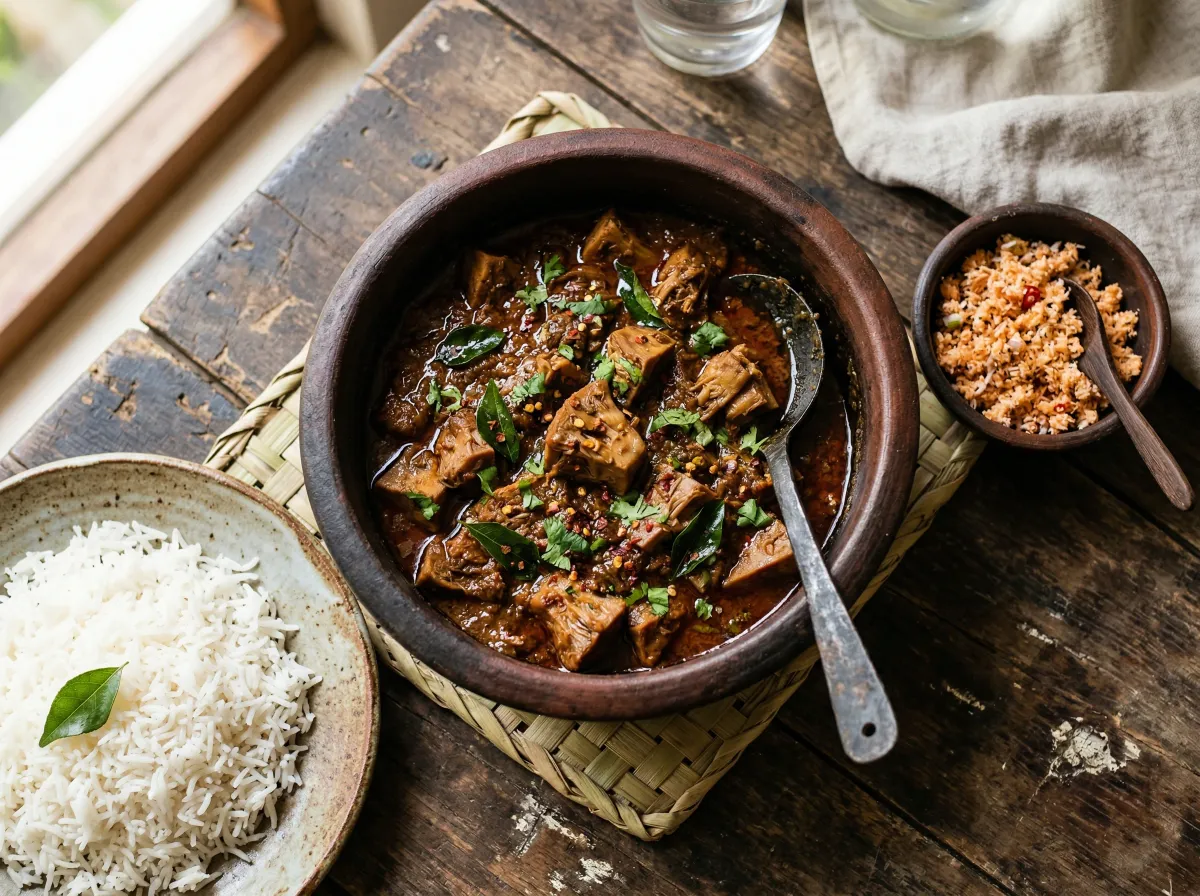
Polos Curry: Sri Lanka's Slow-Cooked Young Jackfruit Curry
Tender young jackfruit simmered low and slow in roasted curry powder, coconut milk, and goraka until the gravy thickens and the oil glistens on top — a rich, deeply spiced Sri Lankan curry that tastes even better the next day.
Prep
20 min
Cook
90 min
Total
110 min
Serves
6
Ingredients
Jackfruit
- 500g fresh young green jackfruit, cut into 3–4cm chunks — or 2 × 400g cans young green jackfruit in brine, drained and rinsed
- ½ tsp turmeric powder (for soaking fresh jackfruit)
Spice mix
- 2½ tbsp Sri Lankan roasted curry powder
- ½ tsp turmeric powder
- 1 tsp chilli powder (adjust to taste)
- 1 tsp freshly ground black pepper
Aromatics
- 2 tbsp coconut oil
- 1 tsp mustard seeds
- 1 cinnamon stick (about 5cm)
- 3–4 cardamom pods, lightly crushed
- 3–4 whole cloves
- ½ tsp fenugreek seeds
- 1 medium red onion, finely sliced
- 3 cloves garlic, minced
- 1-inch piece ginger, minced
- 10–12 fresh curry leaves
- 1 pandan leaf (rampe), knotted
- 2–3 green chillies, slit lengthways
Liquid and souring
- 4–6 pieces goraka (dried Garcinia cambogia), soaked in warm water for 10 minutes — or 1 tsp tamarind paste as a substitute
- 200ml thick coconut milk (first extract)
- 200ml thin coconut milk (second extract) — or use 1 × 400ml can coconut milk, reserving half for the final stage
- ½ cup water (as needed)
- 1 tsp salt (adjust to taste)
Method
- 1
Prepare the jackfruit. If using fresh: oil your hands, knife, and cutting board generously — the latex sap is extremely sticky. Remove the tough outer skin and central core, then cut the flesh into 3–4cm chunks. Soak immediately in water with ½ tsp turmeric to prevent browning. Drain before use. If using canned: drain, rinse well, trim off any tough core tips, and halve any large pieces.
- 2
Season the jackfruit. In a bowl, combine the drained jackfruit pieces with the roasted curry powder, turmeric, chilli powder, black pepper, and goraka (or tamarind paste). Mix well so each piece is evenly coated. Set aside while you prepare the aromatics.
- 3
Temper the spices. Heat the coconut oil in a heavy-bottomed pot (a clay pot is traditional) over medium-low heat. Add the mustard seeds and let them splutter. Add the cinnamon stick, cardamom pods, cloves, and fenugreek seeds — stir for 30 seconds until fragrant.
- 4
Add the sliced onion, curry leaves, pandan leaf, green chillies, garlic, and ginger. Sauté on low heat for 4–5 minutes, stirring occasionally, until the onions soften and turn translucent. Do not brown them.
- 5
Add the seasoned jackfruit to the pot and stir well, coating the pieces with the tempered spices. Cook for 3–4 minutes, letting the spices bloom.
- 6
Pour in the thin coconut milk (or the first half of the can) and the water. Bring to a gentle simmer — not a rolling boil. Reduce the heat to low, cover with the lid slightly ajar, and cook for 40–50 minutes until the jackfruit is completely tender and easily pierced with a fork. Stir occasionally to prevent sticking.
- 7
Add the thick coconut milk (or the reserved second half of the can). Continue simmering uncovered on low heat for another 20–30 minutes, stirring now and then. The gravy should reduce and thicken significantly. Look for thel pathuma — a glistening layer of coconut oil separating on the surface — which is the traditional sign the curry is ready.
- 8
Taste and adjust salt. Remove from heat and let the curry rest for at least 20 minutes before serving — the flavour deepens considerably as it sits. Serve with white rice or string hoppers, alongside pol sambol and dhal curry for a traditional Sri Lankan meal.
The Curry That Proves Jackfruit Doesn’t Need to Pretend
Before jackfruit became the West’s favourite “pulled pork substitute,” it was already the star of one of Sri Lanka’s most loved home curries. Polos (young green jackfruit) has been slow-cooked in coconut milk and roasted spices on the island for generations — not as a meat replacement, but as a vegetable in its own right, with a texture and flavour that stands on its own.
Polos curry — sometimes called polos ambula (ambula meaning sour) — is a fixture of the Sri Lankan rice and curry spread. It sits alongside dhal, a fish or meat curry, a green vegetable stir-fry, and pol sambol, forming part of the rotating cast of dishes that makes up a typical home lunch. It’s not glamorous. It doesn’t photograph particularly well. But ask any Sri Lankan what they’d want on their lunch plate, and polos curry is near the top of the list.
If you’ve tried our Sri Lankan fish curry or isso vadai, you’ll recognise some of the same flavour building blocks here — roasted curry powder, curry leaves, pandan, coconut milk. But where those dishes are relatively quick, polos curry rewards patience. This is a low-and-slow curry that transforms tough, starchy young jackfruit into something tender, rich, and deeply spiced.
What Makes This Sri Lankan
Three things set polos curry apart from the generic “jackfruit curry” recipes you’ll find online.
Roasted curry powder is the foundation. Sri Lankan roasted curry powder (badapu thuna paha) is made by dry-roasting coriander, cumin, fennel, and a collection of whole spices — cinnamon, cardamom, cloves, curry leaves, pandan — until dark and deeply fragrant, then grinding them to a fine powder. The roasting produces a nuttier, darker, more complex flavour than raw curry powder. It’s what gives polos curry its characteristic reddish-brown colour and layered warmth. If you can find or make Sri Lankan roasted curry powder, use it — generic “curry powder” from a supermarket will produce a very different dish.
Goraka (dried Garcinia cambogia) is the traditional souring agent. It’s sun-dried, blackened, and slightly smoky, and it gives polos curry a distinctive sour depth that tamarind can approximate but not replicate. The name polos ambula literally means “sour young jackfruit.” If you can source goraka from a Sri Lankan grocery, it’s worth seeking out. Tamarind paste works as a substitute and still produces a good curry — just a different one.
The two-stage coconut milk technique is standard across Sri Lankan curries but essential here. Thin coconut milk goes in first, providing the liquid for the long simmer that tenderises the jackfruit. Thick coconut milk is added at the end, enriching the gravy and giving it that creamy body. You’re looking for thel pathuma — the moment when coconut oil separates and glistens on the surface of the curry — which signals that the coconut milk has reduced properly and the curry is done.
Fresh vs. Canned Jackfruit
Fresh young jackfruit produces the best texture — firmer, meatier, and more satisfying to eat. But it’s also a production to prepare. The latex sap is notoriously sticky, coating your knife, board, and hands in a white gluey film that soap barely touches. The traditional solution is to oil everything generously before you start cutting. Some cooks work over newspaper for easy cleanup.
If you can find fresh young jackfruit at an Asian grocery, it should be small, hard, and uniformly green with no yellowing. The flesh inside should be pale and starchy, with no sweet aroma — if it smells fruity, it’s too ripe for curry.
Canned young green jackfruit in brine (not syrup — never syrup) is a perfectly acceptable shortcut that multiple Sri Lankan cooks endorse. Drain it, rinse it well, trim off the tough triangular core from each piece, and you’re ready to go. The texture is softer than fresh, but the flavour absorbs just as well after a long simmer.
The Slow Cook
There are no shortcuts here. Polos curry needs time. The jackfruit starts out tough and starchy, and the long, low simmer — 40 to 50 minutes in thin coconut milk, then another 20 to 30 minutes with thick coconut milk — transforms it into something tender that absorbs the spice-rich gravy.
A heavy-bottomed pot is essential to prevent scorching. A clay pot (hatti beliya) is traditional and conducts heat beautifully, but any thick-based saucepan will do. Keep the heat genuinely low — the curry should barely bubble, not boil. Stir every 10 minutes or so to prevent the bottom from catching.
The curry is done when the gravy has thickened into a concentrated sauce — what Sri Lankans call borey — that coats the jackfruit pieces rather than pooling around them. The oil separation (thel pathuma) confirms it.
It Tastes Better Tomorrow
This is one of those dishes where resting transforms it. The jackfruit continues to absorb the gravy as it cools, and the spices meld and deepen. If you can, make polos curry a few hours before you plan to eat, or even the night before. Reheat gently on the stove — it will be noticeably better.
This also makes it an excellent meal-prep curry. It keeps well in the fridge for 3–4 days and freezes for up to a month.
How to Serve
Polos curry is part of a rice and curry spread, not a standalone dish. At a minimum, serve it with:
- White rice or string hoppers (indi appa) — the starch that carries the thick gravy
- Pol sambol — coconut sambol with onion, chilli, and lime
- Dhal curry — a thinner, more liquid lentil curry that complements the thick polos
For a fuller spread, add a fish curry, a green vegetable stir-fry (mallung), and papadams. This combination — rice surrounded by small portions of many different curries and condiments — is the heart of Sri Lankan home cooking.
Variations
- Polos with Maldive fish: Some versions add a tablespoon of Maldive fish flakes (dried tuna) to the curry for extra umami depth. Add it with the spice mix in step 2. This makes the dish non-vegan but is a common home-cooking addition.
- Creamier version: For a richer curry, increase the thick coconut milk to 300ml and skip the water entirely. The result is more indulgent but less traditional.
- Spicier version: Add 2–3 dried red chillies to the tempering stage alongside the whole spices, and increase the chilli powder to 1½ tsp. Some Jaffna-style versions are significantly hotter than the southern standard.
- With drumstick (moringa): Some cooks add 2–3 drumstick pieces alongside the jackfruit for a mixed vegetable curry. The drumstick cooks in roughly the same time and adds a different texture.