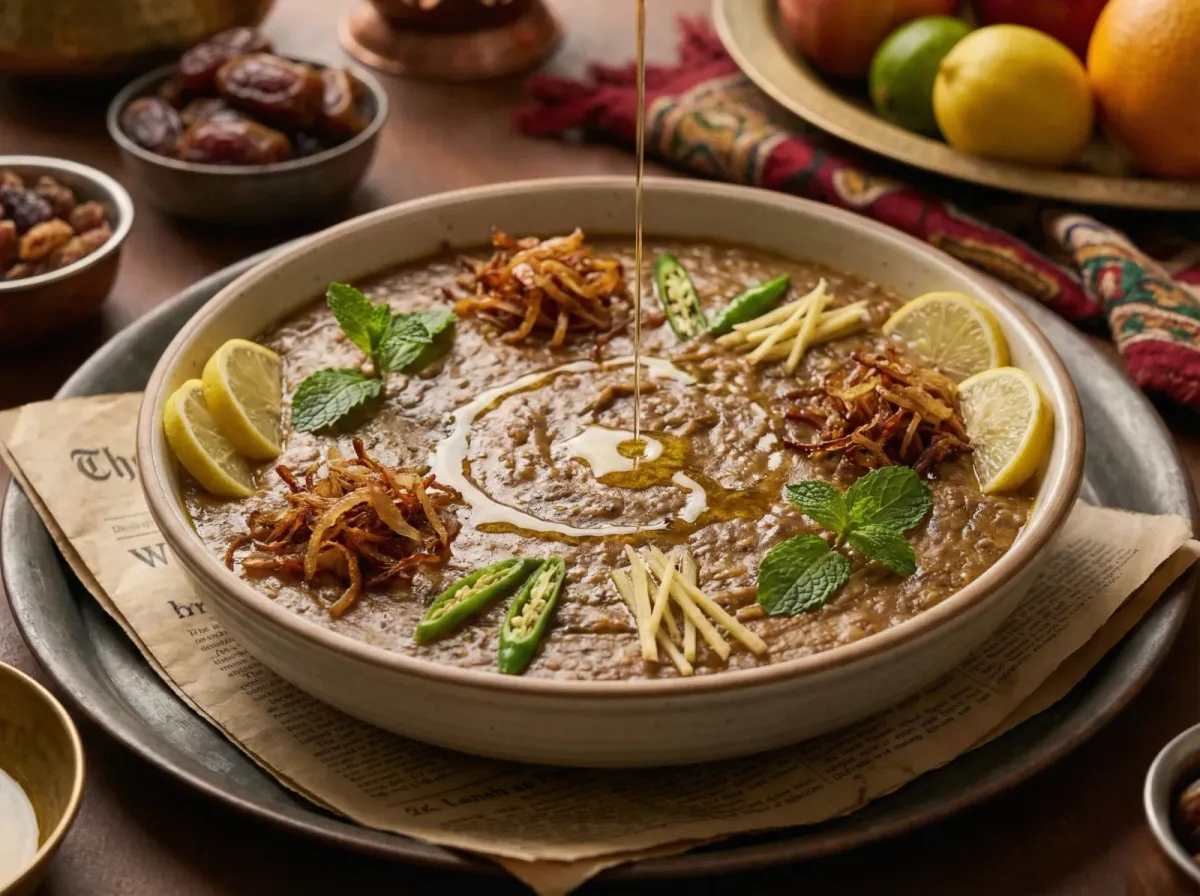
Hyderabadi Haleem: The Slow-Cooked Lentil and Meat Dish That Takes All Day
Wheat, barley, lentils, and mutton pounded into a thick, spiced porridge over 8 hours — Hyderabad's Ramadan staple and one of the most labour-intensive dishes in South Asian cooking.
Prep
60 min
Cook
480 min
Total
540 min
Serves
8
Ingredients
Meat
- 1kg bone-in mutton (goat), cut into medium pieces — shoulder works best
- 250g boneless mutton, cut into small cubes
- 2 tbsp ginger-garlic paste
- 1 tsp turmeric
- 1 tsp salt
- 1.5 litres water
Grain and lentil mix (soak overnight)
- 100g broken wheat (dalia)
- 50g pearl barley
- 50g chana dal (split chickpeas)
- 50g masoor dal (red lentils)
- 50g moong dal (split mung beans)
- 25g urad dal (split black gram)
- 25g rice, any variety
Spice paste
- 4 large onions, thinly sliced
- 3 tbsp ghee or oil (for frying onions)
- 2 tbsp ginger-garlic paste
- 3 tsp red chilli powder
- 2 tsp garam masala
- 1 tsp cumin powder
- 1 tsp coriander powder
- 1/2 tsp turmeric
- 4 green cardamom pods
- 2 black cardamom pods
- 4 cloves
- 1-inch piece cinnamon
- 2 bay leaves
- 1 tbsp poppy seeds (khus khus), soaked and ground to paste
- 10 cashew nuts, soaked and ground to paste
For pounding and finishing
- 3 tbsp ghee
- Salt to taste
Garnish (essential, not optional)
- 3 large onions, thinly sliced and deep-fried until dark golden (birista)
- Fresh mint leaves
- Fresh coriander leaves
- Fresh ginger, cut into fine julienne
- Green chillies, slit
- Lemon wedges
- 1 tbsp ghee, melted (for drizzling)
Method
- 1
The night before: soak all grains and lentils together in plenty of water. They will absorb water and nearly double in volume.
- 2
Day of cooking — cook the meat: place bone-in and boneless mutton in a large pot with ginger-garlic paste, turmeric, salt, and 1.5 litres of water. Bring to a boil, skim the scum, then reduce to a simmer. Cook covered for 2–3 hours until the meat is completely tender and falling off the bone. Remove the meat, shred it finely with two forks (discard bones), and reserve the stock.
- 3
Cook the grains: drain the soaked grains and lentils. Add them to the reserved meat stock (top up with water if needed to keep everything submerged). Simmer for 1.5–2 hours, stirring occasionally, until everything has broken down into a thick porridge. The wheat and barley take longest — they should be completely soft with no bite remaining.
- 4
While the grains cook, prepare the spice base: fry the sliced onions in ghee over medium heat until deep golden brown. Remove half and set aside for garnish (birista). To the remaining onions in the pan, add ginger-garlic paste and cook 2 minutes. Add all ground and whole spices, cook for 3 minutes until fragrant and the oil separates. Add the poppy seed and cashew pastes, cook another 2 minutes.
- 5
Combine everything: add the shredded meat and the spice base to the pot of cooked grains. Stir thoroughly. The mixture should be very thick.
- 6
Now begins the pounding. Traditionally this is done with a large wooden paddle (khunti). At home, use a potato masher or the back of a heavy ladle. Mash and pound the haleem vigorously, breaking down the meat fibres and grain until the mixture becomes a thick, cohesive, paste-like consistency. You should not be able to distinguish individual grains or meat pieces — it should be uniform.
- 7
Continue cooking on the lowest possible heat for another 2–3 hours, stirring every 15 minutes to prevent sticking. The haleem will darken and thicken further. Add ghee in stages — a tablespoon at a time — and stir it in. Taste and adjust salt.
- 8
The haleem is ready when it holds its shape briefly on a spoon before slowly sliding off, and when the texture is completely smooth and homogeneous.
- 9
Serve in wide bowls. Top generously with birista (fried onions), fresh mint, coriander, ginger julienne, slit green chillies, and a squeeze of lemon. Drizzle melted ghee over the top. Serve with naan or sheermal.
A Dish That Demands Your Entire Day
Haleem is not a recipe you decide to make at 4pm. It is a project. The grains soak overnight. The meat simmers for hours. The lentils break down slowly. Then everything is pounded together — traditionally by hand with a heavy wooden paddle — until meat, grain, and lentil become indistinguishable. The whole process takes the better part of a day.
This is the point. Haleem’s extraordinary texture — thick, silky, somewhere between a porridge and a pâté — cannot be achieved quickly. Every hour matters.
Hyderabad’s Relationship With Haleem
Haleem arrived in Hyderabad through Arab traders and was adapted by the Nizam’s kitchens, which added the uniquely Hyderabadi touch of poppy seed and cashew pastes for richness. Today, Hyderabad during Ramadan is essentially a haleem city. Every restaurant, every street stall, and many home kitchens produce haleem daily for iftar (the evening meal that breaks the fast). Haleem is equally central to Eid celebrations — it’s the dish that appears at every major occasion in the Hyderabadi Muslim calendar, not just Ramadan.
The dish has been granted a Geographical Indication (GI) tag — Hyderabadi Haleem is a legally protected designation, recognising its specific origin and preparation method. The city’s other great slow-cooked contribution, of course, is Hyderabadi dum biryani — a very different dish, but the same culture of patience.
The Grain Mix
The combination of grains and lentils is what creates haleem’s layered texture. Each component breaks down differently:
- Broken wheat (dalia) provides the primary body and a slight chewiness
- Barley adds a nutty depth and breaks down into a creamy paste
- Chana dal holds its shape longest and gives subtle sweetness
- Red lentils dissolve almost completely, thickening the base
- Moong dal breaks down smoothly
- Urad dal contributes a distinct creaminess
- Rice dissolves and acts as a binding agent
You can adjust the ratios, but you need the diversity. Using only one or two types of lentil produces a one-dimensional texture.
The Pounding
This is the stage that separates haleem from a thick dal with meat in it. The vigorous pounding breaks down the meat fibres and mashes the grains until the mixture becomes completely homogeneous. In professional haleem kitchens in Hyderabad, teams of men take turns pounding a massive pot with long wooden paddles for hours.
At home, a potato masher works, but a hand blender on pulse — dipped in briefly — can help if your arms give out. Don’t blend it smooth. You want a thick, slightly textured paste, not a purée.
The Pakistani Connection
Haleem is equally beloved in Pakistan, particularly in Karachi and Lahore, where it is called daleem in some communities. The Pakistani version tends to use beef rather than mutton and sometimes includes additional whole spices. The dish connects both culinary traditions — if you’ve made our Beef Nihari, you’ll recognise the same philosophy of long, patient cooking yielding extraordinary depth. For more on what separates Pakistani and Indian food traditions, see our guide to the differences.
The Garnish Is Half the Dish
The toppings on haleem are not decorative. They are functionally essential:
- Birista (fried onions) provide crunch and sweetness against the dense base
- Fresh mint cuts through the richness with brightness
- Ginger julienne adds sharp heat
- Lemon juice provides the acid that lifts everything
- Green chillies give controlled bursts of heat
- Ghee drizzle adds a final layer of richness
Without these, haleem is a thick brown paste. With them, it is one of the most complex and satisfying things you will ever eat. Each spoonful should include a bit of everything.