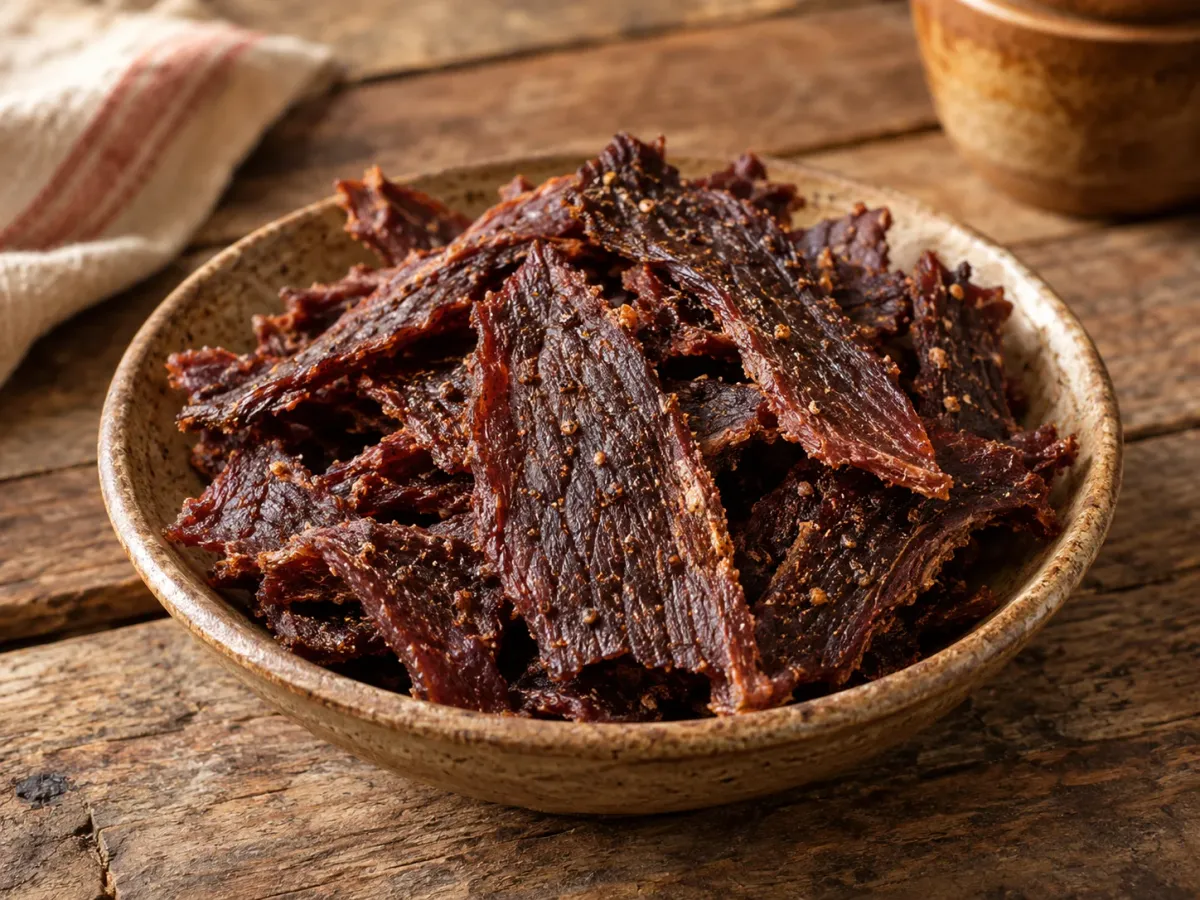
Beef Jerky
Marinate thin lean beef strips, heat them safely before drying, then dehydrate for a chewy Worcestershire-and-smoke jerky.
Prep
25 min
Cook
510 min
Prep + cook
535 min
Yield
About 150–200 g jerky
Estimated timings. Add at least 2 hours or overnight refrigerated marination. Includes pretreatment, equipment heating and up to 8 hours drying; allow complete cooling.
Ingredients
- 450 g lean flank or skirt steak, all visible fat trimmed
- ¾ teaspoon salt
- ¼ teaspoon black pepper
- 1 tablespoon brown sugar
- ¼ teaspoon finely minced garlic
- 2 tablespoons Worcestershire or teriyaki sauce
- ¼ teaspoon liquid smoke
- ¼ teaspoon cayenne, cheese powder or white pepper, optional
Method
- 1
Chill beef in the freezer briefly until firm enough to slice, without freezing solid. Cut into even strips no thicker than 5 mm; cut along the grain for a chewier result. Do not use thick chunks for this method.
- 2
Mix all remaining ingredients, coat beef and refrigerate covered for at least 2 hours or overnight. Keep at 4°C or colder.
- 3
Drain beef and discard marinade. Before drying, steam or roast strips until they reach 71°C (160°F), checking several thick pieces with a food thermometer. For steaming, arrange on a rack above simmering water, cover and heat until the measured endpoint is reached.
- 4
Move heated strips promptly to clean dehydrator racks in a single layer with gaps. Dry at 63°C (145°F) for about 6–8 hours, checking sooner for thin pieces. Use a dehydrator that reliably maintains its set temperature.
- 5
For an oven, use clean wire racks over trays and verify it holds 65°C with an oven thermometer; turn strips halfway. Follow the oven manufacturer instructions for low-temperature drying and ventilation.
- 6
Cool a test strip before checking: it should bend and crack at the edges without a moist centre. Cool the batch completely, pack airtight and refrigerate; freeze for longer storage.
Thin, lean strips dry evenly
Fat stays soft and can become rancid, so trim it closely. Uniform thin slices let moisture leave at a similar rate across the batch. Brief chilling makes slicing easier, but the beef should remain cuttable. Cut along the grain for more chew or across it for a less stringy bite.
Heat before drying
Low drying heat alone is not a reliable pathogen-killing step. USDA jerky guidance calls for beef to reach 71°C before dehydration. Measure the meat itself, then move it to clean racks so it is not recontaminated by raw juices.
Check texture after cooling
Warm jerky feels softer than cooled jerky. Test one piece before deciding the whole batch needs more drying. Refrigerated storage gives you a practical margin for a home batch whose dryness varies. For a fresh beef meal, see teriyaki beef; explore International recipes for other snacks.